
Subscribe to continue reading
Subscribe to get access to the rest of this post and other subscriber-only content.

Subscribe to get access to the rest of this post and other subscriber-only content.
http://gregbarkercoaching.com/
Sincere thanks to Professor Gregory A. Barker on the following book review.
“Towards A Spiritual Humanism” is as a result of many hours of dialogue sessions between Hasan Askari and Jon Avery in June 1989. Hasan and Jon met one another at the Iliff School of Theology in Denver, Colorado where Hasan was the Louise Iliff Visiting Professor. Jon writes in the introduction, “Hasan’s openness, warmth and erudition were engaging, especially in his informal discussions with students after class.” It is with the aspiration for that same sense of openness “SpiritualHuman” is proud to present this book review by Professor Gregory A. Barker.
When The Atheist Met The Mystic
A Review of Hasan Askari and Jon Avery’s Towards a Spiritual Humanism: A Muslim-Humanist Dialogue (1991) 
 Gregory A. Barker. Formerly Senior Lecturer, Religious Studies The University of Wales, Trinity Saint David
A Dialogue Joke?
Did you hear about the Muslim Mystic who found common ground with an American Atheist? That question sounds like the beginning of a joke. It isn’t.
A very unusual book, first published in 1991, brings us a series of discussions between the celebrated esoteric Muslim scholar Hasan Askari and the American humanist Jon Avery.
The book is unusual because these dialogue partners are interested in exploring common ground beyond obvious differences toward metaphysical beliefs.
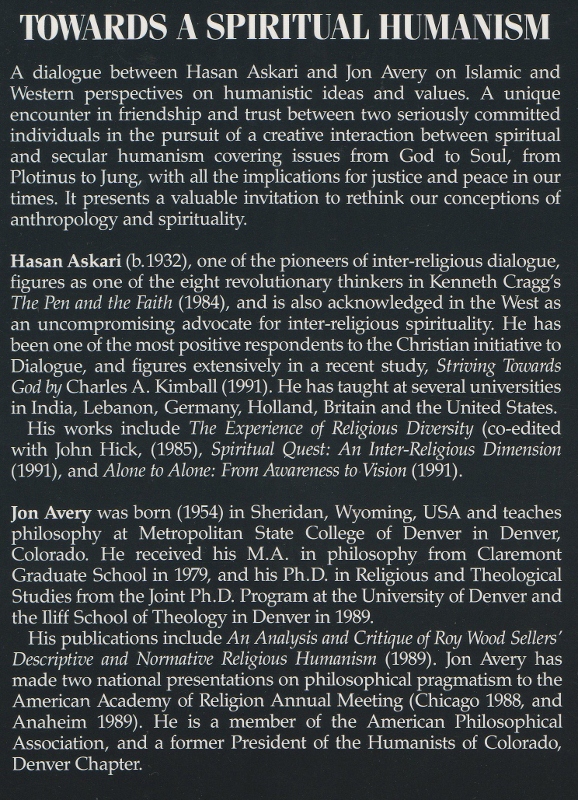 Perhaps what is most striking about the volume Towards a Spiritual Humanism is that it sounds such a different note from the voices we typically hear in our polarized culture.
In popular media, religion and atheism are viewed as locked in debate: religion represents revelation, dogma, and traditional values; atheism champions truth, science, honesty and innovation. Each charges the other with immorality, violence and repression of the human spirit, with atheism currently gaining the upper hand for many with its “slam-dunk” arguments against traditional belief.
Yet many are currently questioning this simple opposition. On the religious side, there are reformulations of traditional theological ideas alongside a social justice agenda which views religion as a force of good in a society that can all too easily lose its soul in nationalism, consumerism and cultural fashions. At the same time a number of atheists are seeking to balance their “no” to traditional beliefs with a “yes” to spiritual values – as the recent book Religion for Atheists (2012) testifies. Askari and Avery’s volume anticipated this current movement.
Twenty Years Ahead of Its Time
Anyone interested in current rapprochements between religion and atheism will be very interested by this book which was, in some ways, twenty years ahead of its time.
Don’t worry: this volume does not end up as a set of vague platitudes or a mutual admiration of liberal social principles. The encounter between these men produces heat as well as light.
Askari describes himself as an esoteric Muslim mystic who utterly rejects the dogmatism that holds contemporary Islamic movements in a “collective hypnosis”, blind to the deeper spiritual unity of the human race. Yet he will not surrender his conviction that there is a transcendent, non-material dimension to the cosmos, a force that unifies and enlightens every human being.
Jon Avery, an atheist, rejects this notion but sees it as a possible corrective to a rationalism that denies the emotional and aesthetic sides to human personality. He also shares Askari’s view that literalist-traditional theologians have created dogmatic approaches to theology that oppress rather than liberate the human spirit.
 Thus, the central disagreement over the non-material transcendent dimension is accompanied by a central agreement over the “sin” of reducing human beings to theological slavery, rationalist one-sidedness or rabid consumers of western products. The two men bring this agreement and disagreement to a host of vital subjects: religion, psychology, the problem of evil and contemporary challenges such as the environment and the threat of nuclear war. Let’s look at just a few of the central concerns.
A Materialistic Universe?
Askari begins by clarifying the nature of his own adherence to Islam. He seeks to locate his own position between a thoroughgoing rationalism on the one hand, and a religious literalism on the other. He has found his own answer in a mystical or esoteric approach witnessed to by a host of thinkers from Plotinus to Carl Jung. A significant shift on his journey came when he accepted the notion that symbols from various world religions witness to unity and transcendence, a position he calls “poly-symbolism” rather than “polytheism”. This view, he says, mitigates against making absolute any one religion and relativizes any claim to “revelation” in terms of a strict set of doctrines and rules. It also challenges, for Askari, the reduction of life to that which can be seen with the physical eyes.
As one might guess, a chasm opens up between the two men on this final point.
Avery agues, “…only matter exists (as long as this matter is understood as evolving and dynamic) is more conducive to happiness than the language of a soul that is separate from the body.” (30) Avery, rooted in his humanist tradition, wants to see humans freed from superstition and religious fanaticism so that they can live in harmony with their physical environment – something, he says, that religious traditions have not always championed.
Askari is concerned that Avery’s view of religion is little more than a superficial ideology, a projection of materialist scholars about the content and direction of religion rather than a serious attempt to reconcile ancient and abiding insights with modern discoveries.
It is clear, says Askari that our intellectual lives operate on a different level from the material systems governing our physical lives.
Avery insists, however, that there is no need to introduce a dichotomy between the soul and the body – they are the same reality. The two then move into a complex argument about motion, with Avery arguing that material movement is self-caused and Askari that all motion is, ultimately, caused by non-material forces. Through this discussion, Avery is concerned that a religious determinism will remove humans from being properly concerned about the material world. Yet Askari argues convincingly that the idea of “self caused motion” is itself a metaphorical interpretation of reality rather than a scientific statement – to which Avery agrees.
Is There A Soul?
Both men use the word “soul” but, predictably, with different meanings. For Jon Avery the soul is a “metaphor for the source of human values” (46); this leads him to define God as the earth and “the soul is the earth in us.” (47). For Askari these definitions are inadequate as they leave humans subject to collective social hypnoses that are destructive to human life; there must be a source beyond ourselves he insists.
The two men are able to agree on the importance of human responsibility, the danger of the doctrine of “original sin” and the idea that human identity is not exhausted by individual consciousness.
Both men are fascinated by Carl Jung and see much promise in the idea that there is a shared humanity, the collective unconscious that unites humans at a deeper level than ideology. Yet, Avery contends that there is a rationalistic explanation for Jung’s archetypes: they are a product of a specific functioning of the human mind, rather than stemming from a mystical source. In other words, the fact that similar categories of thought emerge between otherwise disparate cultures is not necessarily an argument for transcendence but may simply be how the human body works. Still, Avery appreciates the wider view of consciousness provided by a psychoanalytic viewpoint.
At this point Askari passionately declares:
“We need such a unifying principle (i.e. the soul), which connects matter with man and man with the cosmos, in order to realize that the physical images within man and the physical reality outside constitute one reality. Perhaps we don’t know what name we should give to it, but it is at that juncture that we stand today. What can save us from a nuclear holocaust, or a collective destruction of the entire human race, or the destruction of the ecosystem is a glimpse of that unity of the psychic and the physical realms.” (65)
Avery admits that a rationalistic suppression of the emotional and aesthetic dimensions has limited human life and contributed to an exploitation of the earth’s resources. He accepts that there needs to be a human “integration” that accompanies positive progress.
A Spiritual Government?
The dialogue takes a fascinating turn when Askari reflects on attempts to fuse or separate spirituality in politics. Bearing witness to Islamist movements, Askari makes the point that the state inevitably is divinized when it is viewed as a necessary arm of religion. In other words, the state is equated with spirituality and becomes nothing less than an idol that oppresses humanity.
But Askari does not stop here. He believes that America has produced an equally devastating problem through the separation of church and state. By privatizing spirituality, the state becomes free to create powerful ideologies that are immune to spiritual criticism. Here, too, the state is divinized.
At first, Avery objects to this criticism of the United States and champions the justice that has come from the separation of church and state. However, after some further interchange, he admits that the state needs a corrective from a non-ideological point of view.
Askari accuses America as having fostered nothing less than “schizophrenia” between private spirituality and public ideology which leads to an imbalanced soul. His solution is that there should be a unity between our private and public lives — which, for Avery, is best captured by the term “dialectic”. However, for Avery there are forces other than the state that lead to dehumanization; for example, the uncritical use of technology.
A Good or Bad Dialogue Encounter?
Shining through these pages is the fact that both of these men are “Humanists”: each hold human life to be precious, and are convicted about the need to resist the threat to human welfare that comes from war, inhumane actions and the irresponsible use of the environment. However, these men are at odds with their definition of the term “evil”.
This critical difference means that they take a different attitude to human suffering.
For Avery, evil is anything that prevents life from flourishing. He identifies with the “meliorism” of William James: our task it so reduce human suffering as much as possible. However, Askari locates the source of suffering in human ignorance of the underlying unity of life, an ignorance fought against by leading spiritual figures through the ages.
Thus, the book ends with the same tensions introduced at the beginning. Askari is, ultimately, informed by a religious or spiritual vision of life and Avery tends to think that this vision has done more harm than good for human beings.
Askari’s point of view leads him to the striking attitude of questioning that all suffering should be eradicated. Suffering is, he says, a part of the structure of human life. The main enemy is not physical death but absolutizing our own narrow images and ideas about life and holding these as a sword over the heads of others. His vision of “poly-symbolic” pan-spirituality rooted in notions of the divine realm testified to by Plotinus is recommended as an antidote to religious sectarianism and the collapse of the human soul into superficial trends. Scientific reason is not alone going to be able to combat the forces that pull humans into blindness and ignorance, he insists.
But Avery will not so quickly be lured away from his conviction about alleviating all human suffering. Furthermore he sees dangers in superficial spiritual solutions promoted by New Age approaches. Yet, he acknowledges that the answer to the question, “What is the basis for human rights?” must draw upon a different type of reasoning than that normally provided in the rationalist-humanist tradition and he thanks Askari for helping him to seeing that some thinkers from religious traditions have answers to this question that can complement a humanist perspective.
The Meeting Ground
Despite all of these differences, Avery refers to having broken new ground as a result of this dialogue:
“If human rights are an expression of these higher reaches of humanity beyond the physical and dogmatic level in the creative and trans-human levels, then I would agree with you that human rights have a spiritual foundation.” (121).
The use of the term “spiritual” by an atheist is but one of the many features of this dialogue which puts it decades ahead of its time.
Anyone who is not satisfied with polarized portrayals of atheists or religionists will find this book to be a rare gem.
-Gregory A Barker
More on the work of Professor Barker: http://gregbarkercoaching.com/
* See also “Human Nature” above for extract from Towards A Spritual Humanism
*See also “Spiritual Humanism” above for speech transcript by Hasan Askari
*See also “InterReligious Dialogue” above an article by Hasan Askari
The following is the brief introduction to a small book, Seers & Sages (1991), compiled by Hasan Askari and David Bowen. Further below extracts from the book.
Seers & Sages (600 BC to 1850 AC)  “We present here under 40-year cycles from the sixth century B.C. to the nineteenth century A.C the names of both the well-known and lesser known sages, mystics and sufis drawn from all over the world, and also mention, wherever necessary, the schools and the orders they or their followers created. By looking at one cycle, one can notice names from East to West and discover how at one and the same time there were people, scattered in different parts of the world, yet all united in their work to bring to mankind a higher level of awareness. For centuries we were locked up in one particular spiritual geography and history. Now is the time to move from all modes of narrow spiritual patriotism and participate in a broader communion with the elevated souls of all humanity.
We may then realise that we must hesitate before making any exclusive claims on our access to truths that are universally attainable. Now we stand at the threshold of a new cycle, not a new symbol or name, but of an inter-relationship, a neighbourhood, a kinship of spirit, a real community; and the individuals who figure under these “cycles” may therefore be considered as transparently one and many at the same time.
The list offered here can in no sense be considered complete. It cannot possibly include those guides and masters who remain hidden and unknown.” (Hasan Askari / David Bowen)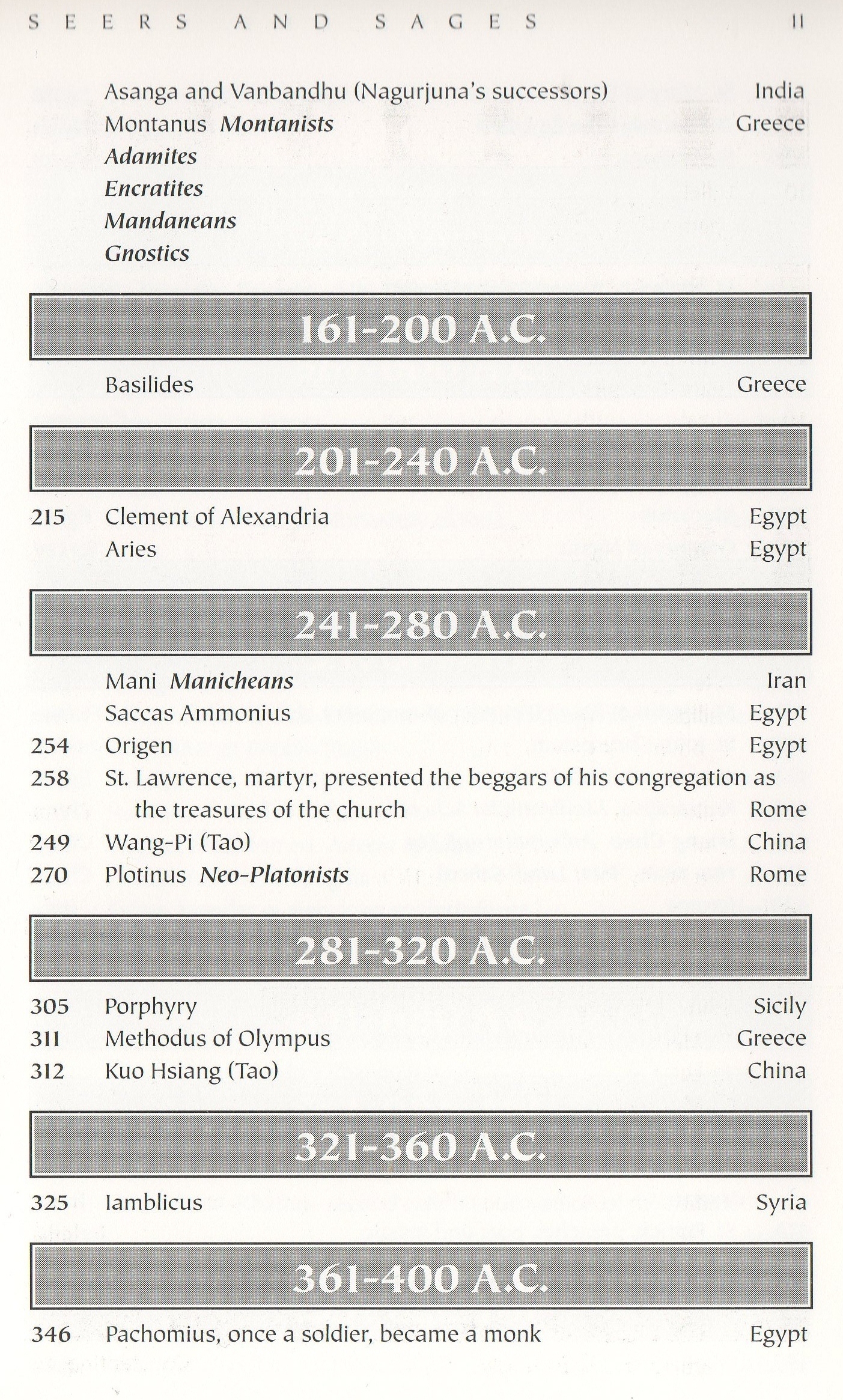

 “Film-maker Antony Thomas has won recognition and acclaim throughout the world for his powerful and thought-provoking programmes. Born in Calcutta, Thomas was taken to South Africa when he was six years old. He moved to England in 1967, where he has written, directed and produced 40 major documentaries and dramas. He is also author of a highly-acclaimed biography Rhodes, the Race for Africa. Thomas’s films have taken the top prizes at numerous documentary festivals, including the most prestigious — the US Emmy Award, the George Foster Peabody Award, the British Academy Award and the Grierson Award for best British Documentary. Two of his documentaries, Twins – The Divided Self and Man and Animal won fourteen international awards between them.
Thomas has succeeded in creating programmes with a strong message that are also highly popular. The opening programme of his 1998 series on obesity, Fat, won three awards from the British Medical Association and was also one of the ten most popular programmes of the week in the UK, with an audience of 9.5 million. When his drama Death of a Princess was originally shown in the United States, it earned one of the highest ratings in the history of PBS, while his 2004 programmes on the Ancient Greek Olympics were sold to 83 countries.
In 2007, his documentary, The Tank Man, was invited for special screenings at the US AGM of Amnesty International and the United States Congress.
His recent work includes a two-hour documentary on The Qur’an (co-produced by Channel 4 and National Geographic) which premiered in the UK on July 14th 2008, and has subsequently been seen in 32 counties; How do you know God exists? which premiered in the UK on August 16th 2009 and For Neda, a documentary special for HBO, which tells story of Neda Agha Soltan…” (For more on the work of Antony Thomas please visit his website http://www.antonythomas.co.uk/ )
Sincere thanks to Antony Thomas for agreeing to this interview.
Musa Askari: As a documentary film-maker you have talked about having “no idea where the beginning, middle and end of the programme is”. I would like to inquire however about another “beginning”. A beginning of questions formulated through your reflections. Questions which perhaps first attract you to a project as like standing at the circumference of a dimly outlined circle with new questions coming to light during the spontaneity of filming as you traverse various radii toward the centre or heart of the piece.
Whenever you undertake a project would it be fair to say it is generally governed by a set of key questions? Also could you please talk a little about how such initial questions of inquiry are arrived at and to what extent you rely upon your instinct and intuition for guidance through the project?
Antony Thomas: Yes. It is fair to say that my work is governed by a set of questions – in some cases a single question. “How do you know that God exists?” “What does the Qur’an actually say?” – to mention two of my more recent films.
What matters most to me is research in depth. “Instinct and intuition” may help to guide one to the right people and the most relevant source material, but the principle aim is to discover as many perspectives as you can on the subject you have decided to tackle, and that has to take place before any filming starts.
Musa Askari: I would like ask about your inner “experience” on the craft of editing. You have talked about there being a period of reflection before the actual editing commences. That “something very strange happens” and eventually the “whole thing seems to fall in to place”. This I find fascinating and grateful if you could share some insights on the experience of “something strange” and the recognition of things falling in to place.
Antony Thomas: We need to distinguish between the two types of programme I’ve been involved on – pure documentary and docudrama. In the case of the latter, one is following a script. It’s an inflexible form; the beginning, middle and end are known before you start filming.
I would never approach “pure documentary” in the same way, because of the danger that one might (consciously or unconsciously) manipulate what is happening in front of the camera so that it fits into the preordained plan. The decision to film a particular scene or to interview a particular individual should be based on the conviction that they are relevant to the story you are telling, but there are times when the whole experience turns out to be very different from what was anticipated, and one must always be true to that.
After the filming is over, I generally spend a couple of weeks looking through all the material that we’ve shot, and it’s quite extraordinary how clearly the structure starts to emerge – and, of course, it’s a structure based on the truth and not on some pre-ordained plan.
Musa Askari: “Withdraw into yourself and look. And if you do not find yourself beautiful yet, act as does the creator of a statue that is to be made beautiful: he cuts away here, he smoothes there, he makes this line lighter, this other purer, until a lovely face has grown upon his work.” Plotinus (The Enneads: 1.6.9)
Plotinus, the father of Neo-Platonism, the mystic-philosopher whose work is soul through and soul, is talking about sculpting as a reference to inner self mastery, a spiritual endeavour. There is on the one hand a sculptor seeking to bring forth a material expression of beauty, and on the other hand a documentary film-maker, in my view, also seeking beauty, perhaps a beauty non-material, not of marble, stone or wood. But rather beauty to be found through heartfelt testimonies of people interviewed, of ideas expressed. In other words a quest for “truth” at the heart of the issue being investigated is a beautiful quest. That “truth” in essence is beautiful but also enlightening, liberating and awakening.
As a principle would you agree that sculptor and film-maker have a common bond in the pursuit of “Beauty”? And in general to what extent would you consider editing akin to the art of sculpting?
Antony Thomas: I have to be very frank about this. I don’t think I’ve ever spoken to a sculptor, or seen a sculptor at work, so I’m not really equipped to answer that question.
Musa Askari: Through your work on “Death of a Princess” (1980), “The Tank Man” (2006) and most recently “For Neda” (2010) these appear to be, apart from the social and political context, powerful representations of individual lives. In your opening sequence to “The Tank Man” for example we are presented with images on the vastness of Tiananmen Square and you comment about “treeless spaces” and “monumental buildings“. As we survey these images of the square your narration talks about, “the insignificance of the individual before the might of the state.”
Could you please talk a little on what you find compelling about individual lives which are caught up within great currents of society and state?
Antony Thomas: As you know, most of my documentaries have strong political or religious themes, but I am not the slightest bit interested in theory and dogma. What matters to me are the practical outcomes. I want to the viewer to feel what it’s really like to be living under this or that system. I don’t want to be up there on podium listening to the Head of State or the Pope, I want to be down on the ground floor of ordinary human experience.
The reviews that make me happiest are those that suggest that this method is working, like this one, in response to a documentary I made in Egypt some time ago: “I have seen many documentaries telling me what it was like to be in Egypt, yet this was the first one to spell out, both beautifully and brutally, what it felt like to be an Egyptian.”
Musa Askari: I find the liberating power of the individual no better expressed in your work than in “The Tank Man”. A lone man standing in the middle of a boulevard, straight, still and defiant. No weapon, just his individuality. It is seems remarkable to me with so much violence having taken place already, so many individual un-armed lives already brutalised the night before on June 4th 1989, why the driver of the lead tank halted at all. What transpired between those two as they stared at each other we may never know. As we witness the bravery of one man standing before the lead tank, an image which has become an icon of freedom, we are also witnessing the actions of another man who is hidden from view. Namely, the driver of the lead tank. Enfolded within the machinery of military power, represented by a tank, the individual is not only insignificant (recalling your quote earlier) but also absent. Yet here in this event, in this image, the individual is unmasked for all to see in the clear light of a noon sun confronting symbolically a state power and in doing so invites the driver of the lead tank, for a few minutes, to become an individual also.
Would you agree perhaps there were two “Tank Men” that day in Tiananmen Square? And I would be grateful for your thoughts on when you first saw the footage of this anonymous individual making a brave and selfless stand.
Antony Thomas: Yes. I certainly remember the powerful emotions I felt when I first saw that image of a young man, standing in front of that column of tanks, and I completely agree with the point you make. There were two heroes that day – one unseen inside the lead tank, and one standing in the road with his back to us. I’m afraid it’s likely that both of them shared the same fate.
Musa Askari: I note your interest in religion, through works such as “Thy Kingdom Come” (1987), “The Quran” (2008) and more recently “How Do You Know That God Exists?” (2009), and present the following quotes from my late father whose work and reputation I understand you are familiar with.
“The prospect of a religion reflecting the Absolute absolutely would turn that religion into the most dogmatic and oppressive belief system imaginable. Hence, there should be room between the religions for mutual critique and complementarity. In turn, this should generate a religious need for religious plurality and diversity.” (Professor Syed Hasan Askari: From Interreligious Dialogue to Spiritual Humanism https://spiritualhuman.co.uk/2011/03/14/from-interreligious-dialogue-to-spiritual-humanism/
“It was Brumana consultation in 1972 in Beirut the biggest Christian – Muslim consultation of the century, that in my paper I made it absolutely clear that perhaps, perhaps we need more than one religion. How could one dare to equate the Almighty Unity and Transcendence and Mystery with the form of one faith and practice?” (Professor Syed Hasan Askari: speech on Spiritual Humanism, 1995 https://spiritualhuman.wordpress.com/speech-hasan-askari-spiritual-humanism/ )
Through your work, research and study of religion could you please talk about your observations when an exclusive one-sided approach to religious witness is taken at the expense of the universal and inclusive? And to what extent do you think the direction of inter-religious dialogue has changed or stayed the same since your interest in religion and inter-faith began?
Antony Thomas: I agree with every word that you have quoted from your father’s writings. The tension and violence, not only between people of different faiths, but between co-religionists is one of the greatest tragedies of our time.
I know many wonderful people who are trying to reach out across these divisions, but in spite of all their efforts, it seems to me that the problem is more serious now that at any other time in my life.

In Memory of Syed Mohmmed Taqui
by Syed Musa Askari
To learn of the passing of a loved one thoughts issue forth like the dawn of a sunrise. The first ray of light followed by countless rays that, due to their brilliance, are now indistinguishable one from the other. There is only light. Light upon Light.
When I heard the news of the passing of my dear uncle Syed Mohmmed Taqui I felt the sun of his soul had fully risen. As if the entirety of a life was akin to the slow gradual rise of the sun above the horizon, the last tip of the sun having bid fare-well to the line of horizon. A line drawn from birth to the moment of passing. A line along which a life had been lived. A line that was drawn horizontally is now drawn vertically leading one to another life, another horizon, another sunrise.
A life lived is more than the trace of footsteps left in its wake. Above all it is a sign of journeying from here to there, from right to left, from below to above. All the rotational points forming a circle of many dimensions. Our life as soul to sojourn knowing the permanence of our abode is “elsewhere”. No place of locality, but eternal, placeless and traceless. To become “homeless” innerly we are home. I pray for the continued safe journey of the soul of Syed Mohmmed Taqui.
When reflecting upon one’s own life or the life of another it is as if we are always watching a sunrise. There is no death only the beginning of another journey. The birth of a life is the sun rising, a new “day”, our whole life as one “day”. For the Soul knows this association with body is but a fleeting moment within many moments.
The reverse I find holds more in it, not the setting of a sun, not the receding light of a life lived but the full glory of a magnificent sunrise. We are left to bathe in the light of his life, the mark of all that was and remains the best of his life. No mark such as that of a seal, of ring impressed upon wax, no impression such as this to be worn away by the weathering of time. Rather a mark made upon one’s consciousness, one’s heart and one’s soul.
The mark of his life summed up in words such as courage, strength, compassion and great humour. I will forever remember the glint in his eye and the warmth of his smile. When these two qualities combined, there in those moments, I recall now one was meeting the essence of his nature.
What to speak of sadness and grief? How to speak of sadness and grief? These deep feelings for us left behind to undergo. Clutching to them like the trailing string of a kite set aloft to the wind, cut free from the bonds of the hand that held it with love during its flight before our eyes. It flies now held by and tugged by another Hand.
A child stands upon a rooftop balcony; a kite flies from its hand. A tug, a lengthening of the string followed by a firm grip. Without warning the kite breaks free, separated from its connection with the earth as like the passing of a life from this world. The face of the child aghast and distressed. The smile upon his face moments ago is no more. A tearful sadness and perhaps a desperation takes hold; a longing to taste again the sense of freedom through the symbol of a kite imparting.
The kite swaying in the wind like a leaf set free from some branch. The trailing string of the kite passing overhead; a prayer leaps forth with hope to reclaim it. The child rushes to the street below and searches patches of sky in-between the towering buildings as if looking for a lone cloud in a cloudless sky. A fleeting glimpse of the kite gliding overhead, the heart races, a memory recalled. He turns corner after corner just about keeping pace with the trailing string but the kite itself is out of view.
His hand outstretched while he runs ahead as if the roles are now reversed. Where the kite once danced to the tune of the child’s hand it is the child which is now beckoned. The joy which was the mark of friendship between the kite and child still remains though now expressed differently. An invisible bond connects them.
This journey of following a kite, a free spirit, akin to a mystical relationship between a master and disciple. One may live an entire lifetime until eventually the kite and follower must part ways. The kite has brought the child to the shores of a mighty ocean and flies on to the horizon. There is sadness; there is grief as like the passing of a loved one.
He raises his hands in prayer to the Supreme, bidding a final fare-well to his beloved kite, his master. A prayer of gratitude, a prayer of friendship, a prayer of love. As his hands pass over his face he feels each line, each groove, each fork and twist. Each line a path the kite had lead him to tread. Each line upon his hands a horizon upon which countless suns had risen and set during the course of their journey. The child has now become a man. He looks up to the horizon. The sun is rising upon the ocean.
It is the dawn of a new life. This journey of longing, sadness, mourning and grief has not been in vain. It has cleansed entire. The kite flies on to the horizon. Soon there is no kite to be seen. Only a glorious sunrise. Each soul moves toward a greater horizon should it so choose. Each kite longs to fly freely to meet the rising sun.
May the Light of a Greater Sun forever shine upon the soul of Syed Mohmmed Taqui. May the horizon to which his soul journeys draw ever nearer.
 Candice Rowland http://fruition2012.wordpress.com/ is an aspiring author on a spiritual journey. Her passion is to HELP others someway, somehow. She cannot say she is religious but religious about all faiths. Candice BELIEVES there is a God with a mighty purpose for all of us to follow. Candice hopes all can listen within to our tiny voice, “If we silence ourselves, God is whispering to us all the time. If we listen long enough we will find our true purpose in life. Anything is possible if you are pure and true in mind, heart, body, and soul.” Candice’s faith resides in Love and Peace. “When one’s soul has found LOVE within oneself, one has found God. When one has found GOD with LOVE peace and tranquility assumes their being. When peace and tranquility begins with one soul, this will transpire to another soul and another and so on.”
“One of a Kind Soul – Hasan Askari” by Candice Rowland
“We have first to wake up from the spell which our collective identity, whether it be of race or of religion has cast upon us, and see the sun of awareness rising in the horizon of our souls, in whose light the hidden grace in each one of us would become visible to the other. As we bow to each other as soul beings, we bow before God who is both in us and above us. What can then prevent us from saying to each other that my soul and your soul is one soul, that our God and your God is one God? We shall then abolish fear, and then our greeting of peace will be a perfect greeting!” Hasan Askari http://www.interreligiousinsight.org/January2004/Jan04Askari.html
Reading Hasan’s words above gives me goose bumps within my own soul every time I read them; how divine his words resonate with souls on a spiritual journey such as mine as yours. His connection with the religious diversity is far beyond wisdom; it was part of his true being to bring all faiths to an interfaith dialogue to speak, to converse with one another of one another’s religious beliefs; to bring understanding within one’s soul to another soul. As Hasan states, “Our coming together in dialogue becomes akin to an act of worship; our exclusive witness is transformed into co-witness; our one-way mission is replaced by mutual mission.”
The one thing Hasan believed man had forgotten which has brought much suffering in the world, forgetting the Supreme (God), and the soul. “The loss of a sense of transcendence from our consciousness, and the accompanying loss of the gnosis of soul, have led first to the degeneration of religion and eventually to the despiritualisation of politics and science.”
Hasan was a man with a mission to somehow, someway to spark awareness in mankind to transcend him back to God and to “our nobler and loftier companion, our Soul.” Hasan directly points out, “First soul, then God! The soul possesses the vision of the Supreme One.” He proceeds to say further in his article, “First one must “Know thyself” (written on Gate of Entrance to the ancient Temple of Delphi) and “Whoever knows his self knows his Lord” (said by the Prophet of Islam).
As Hasan expresses adamantly, “Soul is one and many, a universal being. It is in souls of each other that we encounter each other both individually and universally. We surpass the boundaries of our outer identity.” In other words, we must as spiritual beings find within ourselves, our soul then only then can we move to find God. And when we unite with the soul we find God; then can we see our soul reflected in other souls with different religious backgrounds, race and culture because the soul is universal as so is our God, all is one; we are one.
One quote always remained in my memory from Hasan and this is why I chose this article in particular to try to bring clarity to myself and others on a spiritual journey. It is this, “A real evangelist would be one who brings the good news of universal truths as these are glimpsed through various religious symbols and philosophies.” This rang with vibration within my soul when I read this because if we all could speak of universal truth and not just what we collectively identify with in our culture, this would bring a sort of peace to mankind. Why? As Hasan says: “Our perspectives will expand: we shall not only notice religious diversity as a spatial fact but also value the coming and going through time of teachers and prophets, religions followed by religions – all calling upon us to wake up and humbly bow in self-knowledge before the almighty source of our souls. Then our conversion will be not to this or that religion but to one God (speaking theistically), All Transcendent-All near, All Freedom-Ever New!” How beautiful Hasan wrote this; brings tears to my eyes.
Not only did Hasan write scholarly, spiritual inclined papers with answers to beyond difficult questions one must answer to bring peace to Earth and unity of mankind, but he wrote poetic articles. As such, the “Seven Mirrors.” https://spiritualhuman.wordpress.com/2012/02/19/seven-mirrors-by-hasan-askari/
Reflecting his vision during silence of one candle; reflecting in seven mirrors reflecting seven candles. He then through thought realized, “If the original candle stands for the eternal presence of the Light of God, all its reflections too were eternally present before it. For God there is neither before nor after, neither past not future, but one eternal present, not like our present but a time that includes without division all times.”
And lastly, Hasan’s heartfelt story, “The Rebirth Through My Son.” https://spiritualhuman.wordpress.com/2011/04/25/rebirth-through-my-son-by-hasan-askari/
This is about a father’s journey through his life while in search of meaning knowing the pain and misery he caused to himself and his family.
But his youngest son never gave up on his father. He visited his father because of a bond he could not help from feeling to his father and the longing to want to know more of him. Finally one day the son asked him a question that stirred him within. “It was that evening that all of a sudden he felt that he was renewed deep from within. His son’s remark had demolished his shyness before his son. He felt that they were now brothers.”
And so how Hasan ends the story with a story to his son, “Once a visitor called and said to his father, “I have come to see your son. May I know where he is?” His father replied: “Do not call him my son. I am his son!” How this says it all between Hasan and his son, Musa.
Now this brings me to the end, to Hasan’s son Musa. If was not for Musa I would not have had the beautiful experience of reading Hasan’s work. And because of Hasan’s works it has brought me to a new but reviving view of my spiritual journey.
Hasan, I can only say you are a precious soul for other souls to follow in your footsteps but that would not be right, as you would say, “This is not a journey for the feet; the feet bring us only from land to land; nor need you think of coach or ship to carry you away; all this order of things you must set aside and refuse to see: you must close the eyes and call instead upon another vision which is to be waked within you, a vision, the birthright of all, which few turn to see. (PLOTINUS – The Enneads, 1.6 “On Beauty”)
On this day February 19th, a very special day, I can only say Hasan would be so very proud of his son, Musa. To keep his work alive through his continuing relentless effort or shall I had said “effortless” for Musa. I thank you Hasan for your work; and your loyal son and your best friend, Musa. God Bless both of your souls.
I have only mentioned a couple of Hasan’s articles that resonated with me, but how all of his articles and works are a tremendous awakening for all to read. I encourage you to read them all.
Namaste, Shalom, Salam, Peace,
Candice Rowland
 After hours of discussion about the question of finality claimed by each revealed religion I returned home so exhausted and perplexed that I had no other way to get to the heart of the mystery but to wait, wait in silence, all arguments set aside, all inner turmoil hushed to point of total surrender. I lighted a candle, burnt some incense, and sat down in that tender light, in that refreshing air.
I stayed for a long time with my eyes closed. I felt I was entering a state resembling sleep. All of a sudden I saw seven mirrors with seven reflected candles. The real candle was not visible. A voice said: There is only one real candle. You can never see it. You can see only its reflections.
The vision stayed before me for sometime and then it disappeared all at once. I was fully awake now. I was startled: I had been given the answer. The vision held the key to the solution of the problem of finality.
 The vision was pointing to something more crucial than the familiar idea that each revealed religion held the light from the same source. It was representing something far more decisive that was not so vividly perceptible to us through our discursive approach to the problem. The vision appeared at the limit of that approach. Hence, I continued to ponder keeping the image of those seven mirrors before me, each mirror reflecting the same invisible candle.
What struck me, something which was not so obvious in the beginning, was that each light in each mirror was an immediate reflection of the original light without any interval of time. All belonged to one moment of receiving the image, no one image following the other. If the original candle stands for the eternal presence of the Light of God, all its reflections too were eternally present before it. For God there is neither before nor after, neither past not future, but one eternal present, not like our present but a time that includes without division all times. No one reflection has any priority, whether temporal or qualitative, over the other reflection, their original being one light. The reflections themselves are not many lights. They are one indivisible light even in their reflected status. Only the number and the diversity of mirrors which emerge in the temporal order divide that one reflection into many reflections. Otherwise, we have to suppose as many gods as there are revelations at different moments of history. The vision did not have seven original candles reflected in seven mirrors but only one original candle with seven reflections all at once.
The vision became so decisive for my understanding and further contemplation that I made a small representation of the seven mirrors and one hidden candle to be permanently kept in my room. Each evening I used to light the candle and watch the miracle of its seven reflections filling those mirrors. I could see the seven mirrors with their seven reflections but I could not see their unity as a physical object.
 The vision perhaps represents our own reality: our seven powers of touch, smell, taste, hearing, sight, memory and imagination, each a different mirror holding a different picture, and yet all being one light which stands before them, namely the light of judgement, that invisible light without which no faculty can operate, without which there could be no unity of knowledge and consciousness. It is the unity of the act of reason that gives to the diversity of our faculties its validity and organization. Diversity of phenomena is no argument against the unity of their source. One may regard each of our faculties as a “revealed religion”.
(This reflection from Hasan Askari’s book : Alone to Alone, From Awareness to Vision)
“Reflections on the Prayer of St Francis of Assisi” by Musa Askari
“Lord, make me an instrument of your peace.
Where there is hatred, let me sow love;
where there is injury,pardon;
where there is doubt, faith;
where there is despair, hope;
where there is darkness, light;
and where there is sadness, joy.
O Divine Master, grant that I may not so much seek
to be consoled as to console;
to be understood as to understand;
to be loved as to love.
For it is in giving that we receive;
it is in pardoning that we are pardoned;
and it is in dying that we are born to eternal life. Amen”
It was my late father, Syed Hasan Askari, who introduced me to the prayer of St Francis many years ago. My introduction came in the form of hearing it read aloud. Perhaps to come to a new prayer not by reading it first but by hearing it one is somehow able to let the prayer rest more gently upon one’s soul. Especially if hearing it read by a person one trusts. Therefore, prayer may also be understood not only as a sign of devotion but also trust between seekers of truth and greater still a sign of Trust in a Higher Power to which the prayer is directed.
To hear such words of love and devotion for the first time resonated very deeply. In the years to follow the prayer would become one among many of my constant sources of inner support. I would not only read it in silence or remember it during the course of a day but moreso I would make a point of reciting it by whispering it to myself at some late hour of the night. Through this whispering recital the prayer became more real, an experience, not only of emotional support but far beyond that to moments of experiencing the prayer as a form of being itself. That it almost had a life of its own. A life in which I was hoping to participate if only momentarily due to varying levels of inner intention and alterness.
Over and above the actual form, order and beauty of the words it is worth exploring, if only superficially through this reflection, the manner in which the prayer is working upon our inner being. What is its outer effect and what is its inner influence? What kind of inner preparation is required to utter such words as authentically as possible? If one is an “instrument” it begs the question who is the invisible artist and what is the melody that is being played? In what way, if at all, do the first and second verses talk to one another? Does a prayer stop when we have finished uttering its words of devotion and praise? Or is there a life, above our own embodied life, in which the prayer perpetually participates? Are prayers, in the form presented to us by inspired individuals who first uttered them, an echo of a far greater recital of praise and devotion that goes on above our consciousness?
Where there is an echo there must be a source from which it emanates. Where there is vibration there must be the beat of a drum. Where there is beauty there must also be the eye which recognises it as such. Where there is thought there must a thinker. And where there is a question there must be a clue or the answer complete. Is there such a question and answer present within the prayer of St. Francis? Is there any such dialogue implied between the one who prays and One to whom the prayer is directed?
At first glance perhaps not. However, if one looks more closely, at the first verse in particular, the following may be a clue where there are six question and answers present and not only that but clear intruction or remedy provided.
Take for example the line, “where there is injury,pardon”. By considering it as three lines a dialogue becomes apparent:
We ask, “Where is injury?”
The prayer answers, “There is injury”
Remedied by, “Pardon.”
Take another line: “where there is despair, hope”:
We ask, “Where is despair?”
The prayer answers, “There is despair”
Remedied by, “Hope.”
Is it not so that through most of our heartfelt prayers, either handed down by tradition or uttered by oursevles spontaneously, we somehow feel in “conversation” with the Supreme? It is into such a “conversation” the prayer of St Francis invites us to enter. In other words, consciously or unconsciously, the human soul is in constant “communication” with its Source. A Source from which it emanates and to which it longs to return. It is perhaps this “communication”, this greater dialogue, that the prayer somehow lifts the reciter innerly to become more conscious of. All great prayers take us in this direction. The prayer becomes a door into another kind of awareness.
Prayer, as both dialogue and a form of worship, is a most peculiar kind of dialogue. We are asking questions and we hear only our voice. A voice that may be frail and shaking, through some traumatic experience, or overjoyed with gratitude for what we have been shown or recevied. The answer to our prayers, however, is heard in silence. The Great Silence of The Supreme Presense, the First and the Last. The Hidden and the Manifest, everywhere and yet nowhere, Immanent and Transcendent. I am reminded of the following from an much earlier piece of writing of mine, “It is in such silence that the Divine Command is uttered perhaps”(The Sound of Silence, 1992) https://spiritualhuman.wordpress.com/2011/02/28/the-sound-of-silence/
In our corporeal nature we hear corporeal things. How can the physical ear hear an answer from One who is Supremly immaterial and Beyond Being? Therefore, silence and patience become the means through which our inner ear becomes more atuned and there we may wait, atentive, alert, humble and above all listening by stilling all distraction within our lives, touching the fringes of a greater peace. Hearing as it were by another mode.
In the prayer of St. Francis we have a deeply moving dynamic where not only are question and answer co-present but also the remedy or instruction to the question. The prayer consoles, reassures and embraces all at once. There is no delay in compassion. The remedies of love, pardoning, hope, faith, light and joy are instantly provided as soon as the question and answer are complete. Infact, the prayer does not wait to be asked how one corrects the disorder within and without. It rushes the remedy towards us faster than we inhale our next breath. Life before life.
One may choose simply to reflect or meditate upon only one line of the prayer and be moved beyond measure. The question, “where is despair?” may be asked outwardly addressing the world and we are presented with images of oppression between human beings or come across testimonies of those who continue to suffer and through such images and accounts we are told innerly, “look! there is despair”. All one need do is ask the question wholeheartedly, compassionately and sadly too many answers come flooding to our consciousness of lives lived in despair. The prayer challenges to ask and notice the other and by doing so abolish otherness from our being. One need not look far to see despair if one chooses not to walk by on the other side. On the other hand the same question maybe asked about oneself to oneself, “where is despair?”. Here personal courage is needed, for now we are looking into the face of our lives and should we be able to peer with unwavering inner strenth the answer comes, “there is despair”, directing us to some long forgotten memory or unravelling chains of thought which enslave and cripple us mentally, distancing us from the world and from ourselves.
To both outward and inwardly directed questions on despair the answer is the same, “hope”. In other words, do not despair, there is hope. The very question itself is “hope”. The question carrying within itself its own liberating power. The question is hope “embodied” as a thought. The question cannot come from an abyss of utter want or lack, the question must carry with it the source which sent it on its way. As referred to previously; the prayer consoles, reassures and embraces all at once. It can only do so if it is enveloped by an inspired inspiration. In the outer form of one line, the question and answer go hand and hand, as like two hands coming together in prayer.
Further, the first verse gives us another insight. It offers a definition of “peace”. Of what “peace” means when commencng a recital of the prayer. Here peace is to love. It is also to pardon, to have faith which implies to trust, to be hopeful for the Light of the One to whom the prayer is addressed is neverfailing and our overriding inner state of such peace in that moment is to be joyful.
The prayer of St. Francis begins in the name of peace and that is perhaps why it has survived to this day and recited by so many. The human heart in perpetual quest for peace. If humanity’s “humanity” is to mean anything it must surely begin with peace regardless of it being called sacred or secular. The Russell – Einstein Manifesto (1955) sums it up beautifully, “We appeal as human beings to human beings: Remember your humanity, and forget the rest.”
Would that those who wage war in the name of “peace” remember such qualities of peace as offered by St. Francis. Would that they pause and re-think in “silence” if they truly are bringing peace or the oppositie of peace which the prayer of St. Francis does not shy away from making clear. Namely, hatred, injury, doubt, despair, darkness and sadness.
In my view the first verse is where the inner work is to be done. The first verse prepares the inner ground, turns the soil, so that we may “sow” such seeds as love and hope. Thus making the earth of our being a fertile ground from which may spring, over the ocean of our consciousness, all that the second verse leads us toward. The second verse finally frees us from enslavement to our ego-bound mindlessness. Of collective hypnosis from our exclusive one-sided attitudes to identities of race, ethnicity, culture, creed and ideology (religious or humanist).
We are in a totally new frame not only of mind but consciousness when proceeding through the second verse line by line. When the first verse has “consoled” us, “understood” and “loved” us like a kind friend or beloved. When it has enriched and pardoned us our failings. When we have been transformed within and without through the power of the first verse then, and only then, we may truly mean the words which pass by our lips of surrender from the second verse. We ask nothing for ourselves when we have been given more than could have been asked for. Now, one may recall how the prayer began, “Lord, make me an instrument of your peace”.
Through the discourse on soul we are told body is the instrument of soul, the material is later to the immaterial. Yet, it is not the body which seems to be the “instrument” implied when we notice how the prayer ends, “it is in dying that we are born to eternal life.” What other could it be that perishes, passes away, than body? And what other than soul could we speak of when we speak of life eternal? It is soul that has the right to eternal life. Only soul un-embodied remains immortal. Soul, impartible, invisible, indivisible, non-material companion of our self, both one and many at the same time.
The higher levels of the beautfiul prayer of St. Francis may only be reached when perhaps we consider the prayer to a prayer of the soul. An echo of a greater prayer that continues above our consciousness. What the words of that greater recital may be, only as souls shall we come to know. Soul, here and now. Peaceful greetings to the soul of St. Francis of Assisi.
I conclude this brief reflection with the words of my teacher:
“Pray that you are granted an unbroken awareness of your higher soul, that which is the authentic principle of your being, that un-embodied, immortal, all pervading reality, which is one and entire everywhere, every time; that which is in perpetual contemplation of the Divinity above it, that which remains separate, apart, above all you do, relate, experience and suffer as a…body here. Remember it, for it is the true source of your peace and power. Remember.” (Hasan Askari, “Pray” from his book “Alone to Alone”)
Originally published as guest article http://soul-licious.com/?p=918 Thank you to Mia Caruso for asking me to write about the Prayer of St Francis.
See also: Prayer for my Parents & O Light of Lights
“The Eternal One” by Lee & Steven Hager
reflection on the work of Hasan Askari
We didn’t have the privilege of meeting Hasan Askari while he walked
this earth, but we have come to know him through his son Musa, and his
abiding spirit that continues to live through his words. As Hasan
himself said, “A book written by a sage is like the residence in which
he still lives.” We felt especially drawn to Hasan because he was
among those rare seekers who looked both within and then is also able
to look without. He recognized, “Before we ask about the other out
there, we should ask about the other in us, our nobler and loftier
neighbor and companion, Soul.” But instead of becoming caught up
solely within his personal inner explorations as many do, Hasan turned
his attention to the problems that fill our world. His work speaks of
his heartfelt desire to help others look past the outward religious
dissimilarities that separate us and instead discover the great truths
that unite us all at the core.
Enlightenment can be described as an inner awakening that allows us to
see past the illusion of separate forms and realize the Oneness of All
That Is. Hasan wrote, “The life which is multiple and diverse at the
human end is One at the Divine end.” He was not the first person to
awaken to this truth, and he won’t be the last, but it was extremely
important to him that we all see beyond our humanity and make a
connection at the level of the soul. Hasan recognized that while
religion has often been a huge bone of contention, it can also become
a tool for unity when we understand that all souls are united by the
same eternal truths, and those seeds of truth can be found within
religion when we look past the surface.
In the introduction of his translation of “Solomon’s Ring: The Life
and Teachings of a Sufi Master,” Hasan said, “I was looking for a
language which could make dialogue possible and mutually enriching
between people of different religious traditions. I was already free
from sectarian and religious dogmatism…Real speech was for me a
linking of soul with soul.” Hasan found that language when he
discovered the distinction between belief and faith. He wrote, “While
belief is a part of the cumulative tradition, faith is the personal
immediate possession of each individual by which one relates to one’s
life…faith is thus an inner ability to relate and communicate without
fear”
So much of the world’s self-imposed misery could be avoided if
humanity embraced that understanding. As Hasan recognized, we often
mistakenly cling to the trappings of religion, much as we cling to the
outer trappings and traditions of our national origins, because we
mistakenly believe they define us. In doing so, we fail to ask
ourselves how something that is essentially non-material (the Self or
soul) could be defined by something associated with the material. We
become militant in their defense because we fear being swallowed up
and lost, but as Hasan pointed out, “Love is the harmony into which
all contradictions resolve.” Love is the glue that holds us in
oneness, but we cannot see it when we’re tied to outward appearance.
But if we dug up several different types of trees and looked only at
the roots, we would find that it’s very difficult to tell them apart.
However, as Hasan recognized, opening ourselves to others requires
courage. Hasan’s son Musa relates that we must first recognize that
the ‘other’ is not truly ‘other,’ but “someone from whom one can
learn; that their experience has something deeply meaningful to
offer.” We find this a frightening prospect because, as Musa points
out, we “run the risk of being transformed positively by the witness
and testimony of the other.” Our first challenge, if we wish to see
positive changes in our world, is to stop seeing anyone else as
‘other’ and embrace Oneness.
We are surely at a critical time in man’s history. Certainly human
beings have always been at odds, but we have never before had the
capability of ending our arguments by obliterating life as we know it.
If there was ever a time to heed the words of visionaries and
peacemakers like Hasan Askari, it is now. Our differences have not
given us anything of value, our oneness can.
Where there is no other, there is no fear. To the extent this
awareness is obscured, fear will rise in the same degree—Hasan Askari
____________
Lee & Steven Hager, the authors of “The Beginning of Fearlessness: Quantum Prodigal Son.” Writing about themselves, “We’re just like you. We have no special qualifications, but after years of struggle, we discovered the key to living a life of fearlessness. If we could, you can too.” Please continue reading more about Lee & Steven and their unique journey of living a life of “fearlessness” http://www.thebeginningoffearlessness.com/
See earlier article on this blog by Lee & Steven “That’s Good” https://spiritualhuman.wordpress.com/2011/09/05/thats-good-by-lee-steven-hager/
FOUR BREATHS
by Hasan Askari
(Alone to Alone: From Awareness to Vision)
 One may concentrate on an idea that connects oneself to the whole of the cosmos and which heightens and deepens one’s self, and at the same time start gently and wholeheartedly breathing within. Which is so important and effective, idea or breathing in, depends upon one’s crucial choice in attention. By accompanying the act of inhaling with attention one touches the fringe of the life of the idea, its universal power and joy.
First however is the breath of purification, of burning away all that is dense and hard, all that is alien.
Second is the breath of returning from the outer limits, from the six directions of front and behind, right and left, above and below, it is a breath of returning to the seventh point, the centre within.
The centre is also the sphere; as a centre it is eternity, and as a sphere it is infinity.
Third is the breath of ascent to one’s archetype remembering that one’s form here below is an image.
The archetype is both the Self and the Cosmos, after the analogy of centre and sphere.
Fourth is the breath of adoration at the appearance of vision before the innerly directed eye, before the thought in rest, stable and gentle.
This discourse has nothing to do with one’s physical and psychological well-being. If one feels physically and psychologically healthy, that is a very minor reward. The relation of the exercise to the life of this world consists in ingathering the positive and helpful forces. The rest, its greater part, lies above consciousness, above the imaging faculty.
However, valuable, whatever be the authority on which they rest, all techniques of self-development in their elaborate rules and details, without the simplicity and willingness to surrender before the Great Work that goes on above our knowledge, are a burden keeping the novice under one illusion after another.
Pay attention to the idea, and hold it invisibly, its wonder and beauty hidden from one’s ordinary sight. Remember how one sows the seed, and hides it, and waits in trust.
 Spiritual Human