Category Archives: Hasan Askari 1932-2008

Spiritual Human Interview with MIT Chaplain Robert Randolph

Robert Randolph, appointed 2007, MIT’s first Chaplain to the Institute. He works with a Board of Chaplains from various religious traditions fostering inter-faith dialogue. You can read more about Chaplain Randolph’s thoughts and reflections through his blog

Sincere thanks to Robert Randolph for agreeing to this interview.

SPIRITUAL HUMAN INTERVIEW WITH ROBERT RANDOLPH

Musa Askari: I found myself generally agreeing when you wrote (from your September 18th 2013 blog entry) : “The phrases “blind faith” and “honest doubt” have become the most common of currency. Both faith and doubt can be honest or blind, but one does not hear of “blind doubt” or of “honest faith.” Yet the fashion of thought which gives priority to doubt over faith in the whole adventure of knowing is absurd.”

In my interview with Professor Gregory Barker I wrote as part of a preamble to a question, “Without the test of “self-doubt” we may regress into absolute entrenchment and become dogmatic (sacred or secular dogmaticism) through and through. Our faith (sacred or secular ideals) may be incomplete without the critical tool of “doubt” where self-critique precedes engagement with the other. It is not an easy task.”

On an individual and intra-personal spiritual level I wonder if you agree there are times when it is necessary in giving priority to “self-doubt” being worked through and can it be considered a spiritual as well a rational exercise? Ploughing furrows, as it were, on the surface of our being from which may spring new shoots of self-understanding and avenues of enquiry. To what extent has “doubt” played a part in your “adventure of knowing”?

Robert Randolph: You ask about doubt and self-doubt and it seems to me that doubt is a constant partner in the search for meaning.  Jesus when challenged by “doubting” Thomas did not tell him that doubt was inappropriate, he simply offered evidence/experience that would answer his questions and he said to him: “Have you believed because you have seen me? Blessed are those who have not seen and yet have come to believe? (Jn. 20:29)  

Those who follow Christ today have not seen yet they believe.  I am a Christian. I have come to God through the Christian Church and because I was born into a Christian family.  The church and family were less a source of answers to questions but rather a context for conversation and experience related to the questions that came up. We bring our doubts to the church and the community contributes to the process of understanding.

 When you live among young adults, doubt is ever present and those with the least doubt are often those who find themselves in the deepest difficulty as things unfold. In any given week it is hard to tell who believes what and things change from week to week.

Coming at the issue from another perspective, I would be hard pressed to argue for loving deity given the nature and substance of the tragedy that literally exploded around MIT in April, i.e. the Marathon Bombing. People here knew the eight year old boy who died; others knew the foreign student studying at Boston University. How do we integrate such horrific experiences? How could those who did this be so close and yet so far from us?

We now know why it happened, who did what and the story gives context.  But questions remain and the outpouring of care, the debate about the punishment of the surviving perpetrator all are part of the process of meaning making.  As time passes the suggestion that love triumphs makes more sense. The story of Jesus gives us a lens through which to seek understanding.  

It is significant to me that Jesus experienced doubt. When he was dying it is reported that he quoted the Psalms asking why God had forsaken him. All of us have times of deep doubt and I take it to be a necessary part of the human experience.

Musa Askari: The following a quote from my late father’s article, “From Interreligious Dialogue to Spiritual Humanism“. Professor Hasan Askari, a pioneer in inter-faith dialogue, writes,”Each religious form should then express the beauty and the splendour, and the transcendence and the mystery, of the Supreme One in terms of its own language and culture, framed in its own historicity and reflected in the vision of its pioneers. To enter into dialogue is to celebrate the splendour of the infinitely Supremely Good, in the unity and diversity of our faiths. By the theological affirmation of religious diversity, our coming together in dialogue becomes akin to an act of worship; our exclusive witness is transformed into co-witness; our one-way mission is replaced by mutual mission.”

Given the broad religious mix of the MIT community, supported by “17 chaplains representing traditions on campus”, how has the Addir Interfaith Program http://studentlife.mit.edu/content/addir-interfaith-program helped to foster religious enquiry? Also I am deeply interested if it has helped participants recognise the “other” as being spiritually significant to oneself? In other words, without the “other” there is no diversity and without diversity we are all the poorer in expressions of beauty, splendour, transcendence and mystery.

Robert Randolph: The Addir Fellows is a critical program. Given the workload at MIT it is easy to fall into a pattern that isolates individuals. The Addir Fellows program is based on a group of students covenanting together to learn about the stranger, i.e. to learn in more than a superficial way about people they do not know.  

Often in Christianity the confrontation with the other is motivated by the desire to attract individuals to the Christian faith. “Go and make disciples”  is a charge to Christians. Islam in like fashion has a dimension of proselyting. There is no compulsion in either case to use force but the intent is to attract those who are vulnerable to the particular faith.  Judaism alone has no impulse to make converts, but Jews remains wary of cultural conversion and the threat posed by inter-marriage. These forces make relationships hard to cultivate because of the fear of unuttered agendas. 

When agendas are denounced, then relationships can grow and the claims of different religious traditions can be offered and heard in community on their own terms. The university is a place where ideas can be talked about  and measured against one another. It has been my experience that over a lifetime people will often learn from others if they are not doing so under threat or duress. Individuals find much, for example in Buddhism that is valuable and they do not have to be Buddhists to benefit.  More importantly, when one recognizes the value of the other tradition, it is hard to vilify those who follow the tradition. More simply, when one knows someone as an individual rather than as symbol,  tensions ease and the world becomes smaller and less frightening. 

Over the years  the Addir Fellows has existed individuals have become more open to the world and that can result in a greater desire to know about the traditions that shape the lives of others.  Addir offers that opportunity and while I do not think knowing the “other” is an end in itself, it is a step in the process of self-integration.

Musa Askari: I note you describe MIT as “a very religious community” and you “define religion fairly broadly.” As Hasan Askari wrote in relation to inter-faith understanding: “When two spiritual cultures meet, a hermeneutic challenge is born. The fate of each one of those cultures depends upon how one interprets the other’s symbolic language.”(Solomon’s Ring). Perhaps a similar challenge also exists in the interaction between humanism and religion/spirituality. On one level the challenge is irreconcilable. On the literal interpretation level of religious scripture, where one can say the challenge is over as per our great strides in scientific endeavour.

However, would you agree on the symbolic level we may yet see the door to greater understanding left ajar? And whilst engagement within the campus community is important, in terms of wider inter-faith life long relations, to what extent is there substantial engagement/dialogue between secular humanists and faith based humanists and how does this manifest itself?

Robert Randolph: The question contrasts “faith based humanists” and “secular humanists” and when you do that I am reminded of the roles I fill when I officiate at public ceremonies, e.g. offering an invocation or benediction at a public function or officiating at a wedding or a funeral.  People ask about why I officiate in circumstances where God is not mentioned and my response is that I do not reveal all that I hold to be true in every role that I fill. 

For example, clergy serve the state when they officiate at weddings. They serve a family when they participate in a memorial service or funeral. The role of the chaplain is therefore in the service of others. Some think of these services as opportunities to promote theological notions; they are not. They are opportunities to be present. 

The appropriate role is to care for those engaged in the transitional moments celebrated in weddings and memorial services. I offer my support and encouragement. When there is a religious tradition that is part of the equation that is incorporated in the service, but otherwise my role is to support the couple by making their wedding vows congruent with their highest ambitions for their marriage. For those needing comfort in memorial services, the task of the chaplain is to make sure their loss is shared and what can be carried away from the celebration is borne together. And always the door is open to further conversation. That is the work of the university chaplain and for some it will appear to be little different from humanism. But over time and in varied circumstances, nuances will be seen and they are not necessarily oppositional.

Musa Askari: I was deeply struck by the following from your article, “The Boston Tragedy : After the Nonsense“, where you quote from your invocation, “We cultivate the strength to go on, Drawing solace from one another and the traditions that offer meaning in our lives. And we shout into the darkness.”

The following from my article of July 2012, “Weapons Without Boundaries : a spiritual-humanist response to terrorism“, “As individuals we suffer, as individuals we grieve, as individuals we hope to rise again above the waterline of trauma and re-gather the shattered pieces of our lives, never forgetting to honour those who have been taken from us prematurely.”

Perhaps we are never more spiritually challenged innerly than when dealing with grief and terrible heartache. Between witnessing the tears of another and the embrace of consolation it may appear no time at all, a few seconds. Yet, innerly between the consoled and consoler so much has been communicated and understood. It is a dialogue without words, a speechless speech. As tangible and intangible as wind blowing through the trees silently. To hold it is hopeless, it holds us and there is hope, one hopes. The swaying of branches a reflection of hearts cradled through the compassion of a fellow human being. It is the rising to the surface the best attributes of humanity out of the worst of circumstances. It is that which outlives the trauma and points the way, perhaps out of the darkness to which you so powerfully refer. 

On an individual, religious-spiritual level, what have been the challenges following the tragic events in Boston earlier this year? Also grateful if you would talk more about what it means to “shout in the darkness”?

Robert Randolph: Here I think we have come full circle, i.e. back to where we began. Again you ask a perceptive question.  The challenge is always to be completely present to those who have been hurt and are hurting in the aftermath of tragedy. We may respond in anger, we may channel judgment but at the end of the day we are present to offer comfort and hope. We can overcome barbarism and the gift we offer is love. We are reminded to love our enemies, to offer our other cheek for anger and our coat for warmth to those who are angry and to those in need.  These are counter intuitive expressions of love. 

When I write about shouting into the darkness, I am speaking for those who believe there is no meaning beyond what we see, feel and touch. They too have voices, but I honor them even as I believe we are heard when we cry out. There it is again, doubt! Ever present, ever near, it is our constant companion.

When The Atheist Met The Mystic

http://gregbarkercoaching.com/

Sincere thanks to Professor Gregory A. Barker on the following book review.

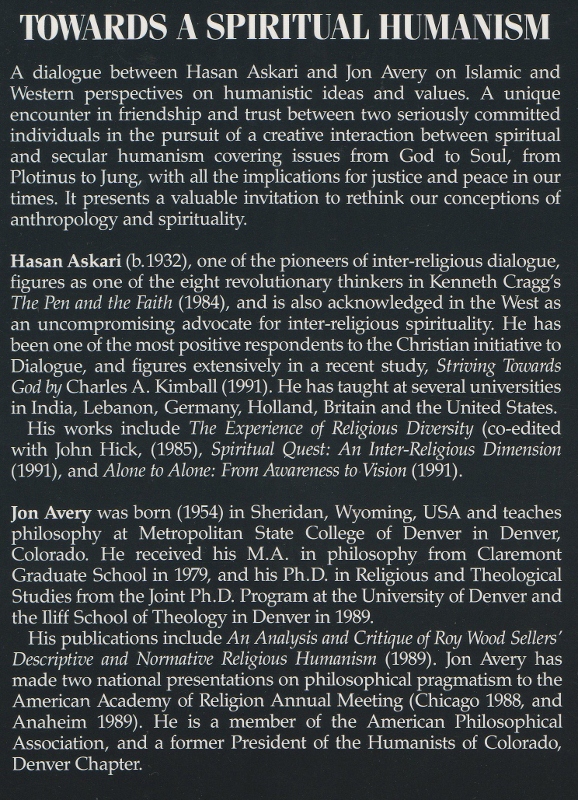
“Towards A Spiritual Humanism” is as a result of many hours of dialogue sessions between Hasan Askari and Jon Avery in June 1989. Hasan and Jon met one another at the Iliff School of Theology in Denver, Colorado where Hasan was the Louise Iliff Visiting Professor. Jon writes in the introduction, “Hasan’s openness, warmth and erudition were engaging, especially in his informal discussions with students after class.” It is with the aspiration for that same sense of openness “SpiritualHuman” is proud to present this book review by Professor Gregory A. Barker.

When The Atheist Met The Mystic

A Review of Hasan Askari and Jon Avery’s Towards a Spiritual Humanism: A Muslim-Humanist Dialogue (1991)

Gregory A. Barker. Formerly Senior Lecturer, Religious Studies The University of Wales, Trinity Saint David

A Dialogue Joke?

Did you hear about the Muslim Mystic who found common ground with an American Atheist? That question sounds like the beginning of a joke. It isn’t. 

A very unusual book, first published in 1991, brings us a series of discussions between the celebrated esoteric Muslim scholar Hasan Askari and the American humanist Jon Avery. 

The book is unusual because these dialogue partners are interested in exploring common ground beyond obvious differences toward metaphysical beliefs.

Perhaps what is most striking about the volume Towards a Spiritual Humanism is that it sounds such a different note from the voices we typically hear in our polarized culture.

In popular media, religion and atheism are viewed as locked in debate: religion represents revelation, dogma, and traditional values; atheism champions truth, science, honesty and innovation.  Each charges the other with immorality, violence and repression of the human spirit, with atheism currently gaining the upper hand for many with its “slam-dunk” arguments against traditional belief.

Yet many are currently questioning this simple opposition.  On the religious side, there are reformulations of traditional theological ideas alongside a social justice agenda which views religion as a force of good in a society that can all too easily lose its soul in nationalism, consumerism and cultural fashions.  At the same time a number of atheists are seeking to balance their “no” to traditional beliefs with a “yes” to spiritual values – as the recent book Religion for Atheists (2012) testifies.  Askari and Avery’s volume anticipated this current movement.

Twenty Years Ahead of Its Time

Anyone interested in current rapprochements between religion and atheism will be very interested by this book which was, in some ways, twenty years ahead of its time.

Don’t worry: this volume does not end up as a set of vague platitudes or a mutual admiration of liberal social principles. The encounter between these men produces heat as well as light. 

Askari describes himself as an esoteric Muslim mystic who utterly rejects the dogmatism that holds contemporary Islamic movements in a “collective hypnosis”, blind to the deeper spiritual unity of the human race.  Yet he will not surrender his conviction that there is a transcendent, non-material dimension to the cosmos, a force that unifies and enlightens every human being.

Jon Avery, an atheist, rejects this notion but sees it as a possible corrective to a rationalism that denies the emotional and aesthetic sides to human personality.  He also shares Askari’s view that literalist-traditional theologians have created dogmatic approaches to theology that oppress rather than liberate the human spirit.

Thus, the central disagreement over the non-material transcendent dimension is accompanied by a central agreement over the “sin” of reducing human beings to theological slavery, rationalist one-sidedness or rabid consumers of western products.   The two men bring this agreement and disagreement to a host of vital subjects: religion, psychology, the problem of evil and contemporary challenges such as the environment and the threat of nuclear war. Let’s look at just a few of the central concerns.

A Materialistic Universe?

Askari begins by clarifying the nature of his own adherence to Islam.  He seeks to locate his own position between a thoroughgoing rationalism on the one hand, and a religious literalism on the other.   He has found his own answer in a mystical or esoteric approach witnessed to by a host of thinkers from Plotinus to Carl Jung.  A significant shift on his journey came when he accepted the notion that symbols from various world religions witness to unity and transcendence, a position he calls “poly-symbolism” rather than “polytheism”. This view, he says, mitigates against making absolute any one religion and relativizes any claim to “revelation” in terms of a strict set of doctrines and rules. It also challenges, for Askari, the reduction of life to that which can be seen with the physical eyes.

As one might guess, a chasm opens up between the two men on this final point.

Avery agues, “…only matter exists (as long as this matter is understood as evolving and dynamic) is more conducive to happiness than the language of a soul that is separate from the body.” (30) Avery, rooted in his humanist tradition, wants to see humans freed from superstition and religious fanaticism so that they can live in harmony with their physical environment – something, he says, that religious traditions have not always championed. 

Askari is concerned that Avery’s view of religion is little more than a superficial ideology, a projection of materialist scholars about the content and direction of religion rather than a serious attempt to reconcile ancient and abiding insights with modern discoveries.  

It is clear, says Askari that our intellectual lives operate on a different level from the material systems governing our physical lives.

Avery insists, however, that there is no need to introduce a dichotomy between the soul and the body – they are the same reality.  The two then move into a complex argument about motion, with Avery arguing that material movement is self-caused and Askari that all motion is, ultimately, caused by non-material forces.  Through this discussion, Avery is concerned that a religious determinism will remove humans from being properly concerned about the material world. Yet Askari argues convincingly that the idea of “self caused motion” is itself a metaphorical interpretation of reality rather than a scientific statement – to which Avery agrees.

Is There A Soul?

Both men use the word “soul” but, predictably, with different meanings. For Jon Avery the soul is a “metaphor for the source of human values” (46); this leads him to define God as the earth and “the soul is the earth in us.” (47). For Askari these definitions are inadequate as they leave humans subject to collective social hypnoses that are destructive to human life; there must be a source beyond ourselves he insists.  

The two men are able to agree on the importance of human responsibility, the danger of the doctrine of “original sin” and the idea that human identity is not exhausted by individual consciousness.

Both men are fascinated by Carl Jung and see much promise in the idea that there is a shared humanity, the collective unconscious that unites humans at a deeper level than ideology.  Yet, Avery contends that there is a rationalistic explanation for Jung’s archetypes: they are a product of a specific functioning of the human mind, rather than stemming from a mystical source. In other words, the fact that similar categories of thought emerge between otherwise disparate cultures is not necessarily an argument for transcendence but may simply be how the human body works.  Still, Avery appreciates the wider view of consciousness provided by a psychoanalytic viewpoint.

At this point Askari passionately declares: 

“We need such a unifying principle (i.e. the soul), which connects matter with man and man with the cosmos, in order to realize that the physical images within man and the physical reality outside constitute one reality.   Perhaps we don’t know what name we should give to it, but it is at that juncture that we stand today.  What can save us from a nuclear holocaust, or a collective destruction of the entire human race, or the destruction of the ecosystem is a glimpse of that unity of the psychic and the physical realms.” (65)

Avery admits that a rationalistic suppression of the emotional and aesthetic dimensions has limited human life and contributed to an exploitation of the earth’s resources.  He accepts that there needs to be a human “integration” that accompanies positive progress.

A Spiritual Government?  

The dialogue takes a fascinating turn when Askari reflects on attempts to fuse or separate spirituality in politics. Bearing witness to Islamist movements, Askari makes the point that the state inevitably is divinized when it is viewed as a necessary arm of religion.  In other words, the state is equated with spirituality and becomes nothing less than an idol that oppresses humanity.

But Askari does not stop here. He believes that America has produced an equally devastating problem through the separation of church and state.  By privatizing spirituality, the state becomes free to create powerful ideologies that are immune to spiritual criticism. Here, too, the state is divinized.

At first, Avery objects to this criticism of the United States and champions the justice that has come from the separation of church and state. However, after some further interchange, he admits that the state needs a corrective from a non-ideological point of view.

Askari accuses America as having fostered nothing less than “schizophrenia” between private spirituality and public ideology which leads to an imbalanced soul.  His solution is that there should be a unity between our private and public lives  — which, for Avery, is best captured by the term “dialectic”.  However, for Avery there are forces other than the state that lead to dehumanization; for example, the uncritical use of technology.

A Good or Bad Dialogue Encounter?

Shining through these pages is the fact that both of these men are “Humanists”: each hold human life to be precious, and are convicted about the need to resist the threat to human welfare that comes from war, inhumane actions and the irresponsible use of the environment.  However, these men are at odds with their definition of the term “evil”.

This critical difference means that they take a different attitude to human suffering.

For Avery, evil is anything that prevents life from flourishing. He identifies with the “meliorism” of William James: our task it so reduce human suffering as much as possible.   However, Askari locates the source of suffering in human ignorance of the underlying unity of life, an ignorance fought against by leading spiritual figures through the ages.

Thus, the book ends with the same tensions introduced at the beginning.  Askari is, ultimately, informed by a religious or spiritual vision of life and Avery tends to think that this vision has done more harm than good for human beings.

Askari’s point of view leads him to the striking attitude of questioning that all suffering should be eradicated. Suffering is, he says, a part of the structure of human life.  The main enemy is not physical death but absolutizing our own narrow images and ideas about life and holding these as a sword over the heads of others.   His vision of “poly-symbolic” pan-spirituality rooted in notions of the divine realm testified to by Plotinus is recommended as an antidote to religious sectarianism and the collapse of the human soul into superficial trends.  Scientific reason is not alone going to be able to combat the forces that pull humans into blindness and ignorance, he insists.

But Avery will not so quickly be lured away from his conviction about alleviating all human suffering.  Furthermore he sees dangers in superficial spiritual solutions promoted by New Age approaches. Yet, he acknowledges that the answer to the question, “What is the basis for human rights?” must draw upon a different type of reasoning than that normally provided in the rationalist-humanist tradition and he thanks Askari for helping him to seeing that some thinkers from religious traditions have answers to this question that can complement a humanist perspective.

The Meeting Ground

Despite all of these differences, Avery refers to having broken new ground as a result of this dialogue:

“If human rights are an expression of these higher reaches of humanity beyond the physical and dogmatic level in the creative and trans-human levels, then I would agree with you that human rights have a spiritual foundation.” (121).

The use of the term “spiritual” by an atheist is but one of the many features of this dialogue which puts it decades ahead of its time. 

Anyone who is not satisfied with polarized portrayals of atheists or religionists will find this book to be a rare gem.

-Gregory A Barker

More on the work of Professor Barker: http://gregbarkercoaching.com/

* See also “Human Nature” above for extract from Towards A Spritual Humanism

*See also “Spiritual Humanism” above for speech transcript by Hasan Askari

*See also “InterReligious Dialogue” above an article by Hasan Askari

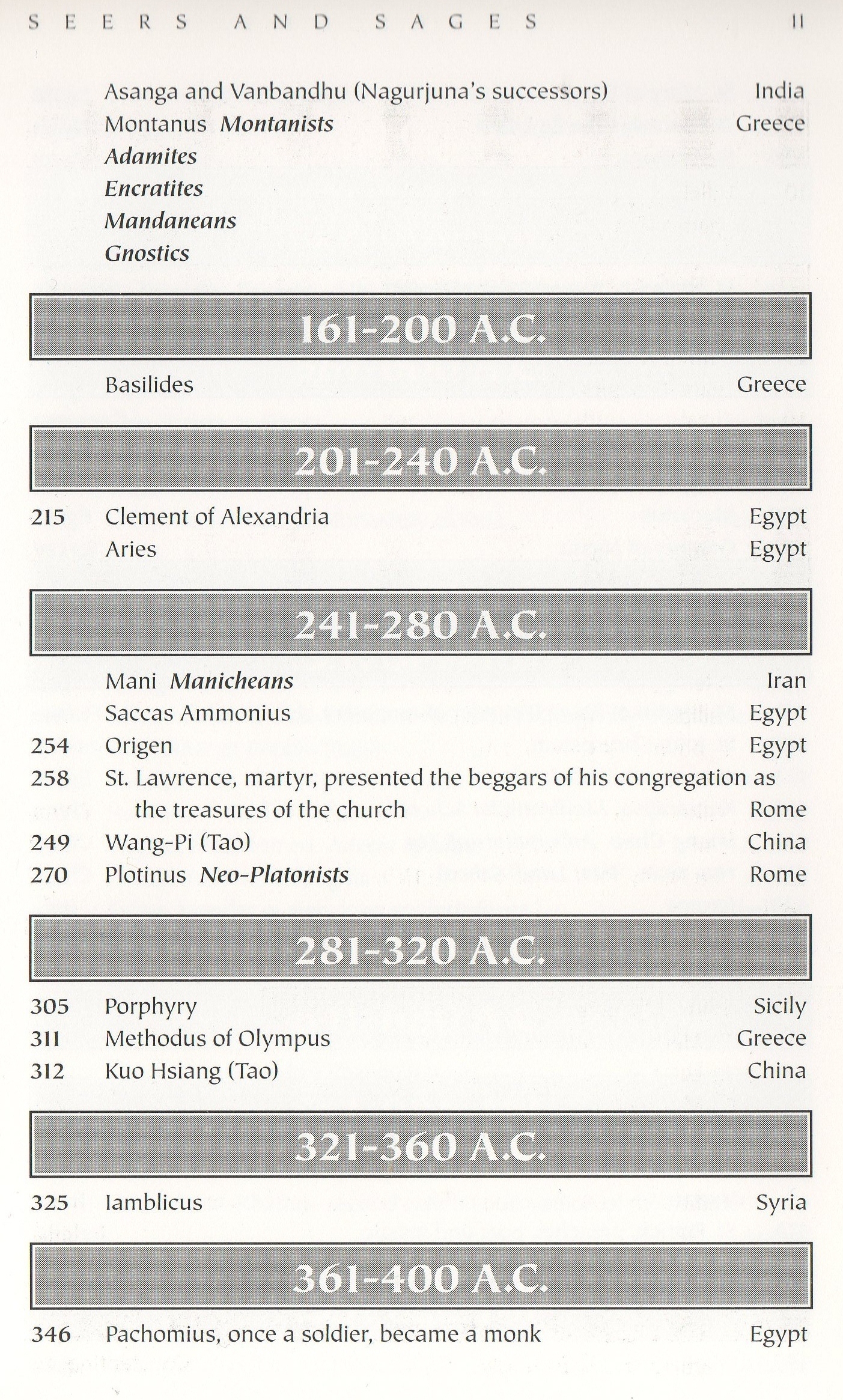
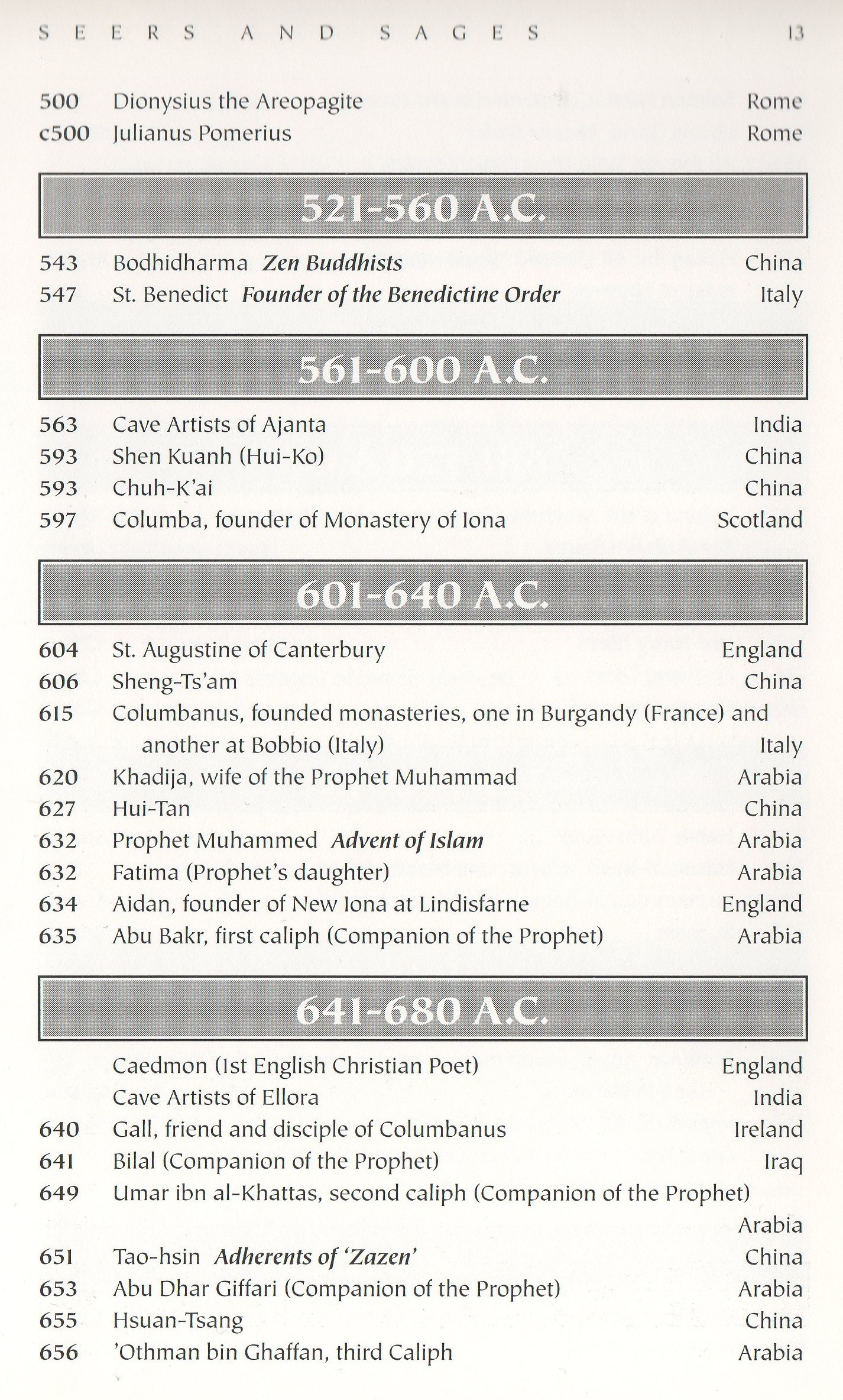
“Seers & Sages” Compiled by Hasan Askari / David Bowen

The following is the brief introduction to a small book, Seers & Sages (1991), compiled by Hasan Askari and David Bowen. Further below extracts from the book.

Seers & Sages (600 BC to 1850 AC) “We present here under 40-year cycles from the sixth century B.C. to the nineteenth century A.C the names of both the well-known and lesser known sages, mystics and sufis drawn from all over the world, and also mention, wherever necessary, the schools and the orders they or their followers created. By looking at one cycle, one can notice names from East to West and discover how at one and the same time there were people, scattered in different parts of the world, yet all united in their work to bring to mankind a higher level of awareness. For centuries we were locked up in one particular spiritual geography and history. Now is the time to move from all modes of narrow spiritual patriotism and participate in a broader communion with the elevated souls of all humanity.

We may then realise that we must hesitate before making any exclusive claims on our access to truths that are universally attainable. Now we stand at the threshold of a new cycle, not a new symbol or name, but of an inter-relationship, a neighbourhood, a kinship of spirit, a real community; and the individuals who figure under these “cycles” may therefore be considered as transparently one and many at the same time.

The list offered here can in no sense be considered complete. It cannot possibly include those guides and masters who remain hidden and unknown.” (Hasan Askari / David Bowen)

Seven Mirrors by Hasan Askari

After hours of discussion about the question of finality claimed by each revealed religion I returned home so exhausted and perplexed that I had no other way to get to the heart of the mystery but to wait, wait in silence, all arguments set aside, all inner turmoil hushed to point of total surrender. I lighted a candle, burnt some incense, and sat down in that tender light, in that refreshing air.

I stayed for a long time with my eyes closed. I felt I was entering a state resembling sleep. All of a sudden I saw seven mirrors with seven reflected candles. The real candle was not visible. A voice said: There is only one real candle. You can never see it. You can see only its reflections.

The vision stayed before me for sometime and then it disappeared all at once. I was fully awake now. I was startled: I had been given the answer. The vision held the key to the solution of the problem of finality.

The vision was pointing to something more crucial than the familiar idea that each revealed religion held the light from the same source. It was representing something far more decisive that was not so vividly perceptible to us through our discursive approach to the problem. The vision appeared at the limit of that approach. Hence, I continued to ponder keeping the image of those seven mirrors before me, each mirror reflecting the same invisible candle.

What struck me, something which was not so obvious in the beginning, was that each light in each mirror was an immediate reflection of the original light without any interval of time. All belonged to one moment of receiving the image, no one image following the other. If the original candle stands for the eternal presence of the Light of God, all its reflections too were eternally present before it. For God there is neither before nor after, neither past not future, but one eternal present, not like our present but a time that includes without division all times. No one reflection has any priority, whether temporal or qualitative, over the other reflection, their original being one light. The reflections themselves are not many lights. They are one indivisible light even in their reflected status. Only the number and the diversity of mirrors which emerge in the temporal order divide that one reflection into many reflections. Otherwise, we have to suppose as many gods as there are revelations at different moments of history. The vision did not have seven original candles reflected in seven mirrors but only one original candle with seven reflections all at once.

The vision became so decisive for my understanding and further contemplation that I made a small representation of the seven mirrors and one hidden candle to be permanently kept in my room. Each evening I used to light the candle and watch the miracle of its seven reflections filling those mirrors. I could see the seven mirrors with their seven reflections but I could not see their unity as a physical object.

The vision perhaps represents our own reality: our seven powers of touch, smell, taste, hearing, sight, memory and imagination, each a different mirror holding a different picture, and yet all being one light which stands before them, namely the light of judgement, that invisible light without which no faculty can operate, without which there could be no unity of knowledge and consciousness. It is the unity of the act of reason that gives to the diversity of our faculties its validity and organization. Diversity of phenomena is no argument against the unity of their source. One may regard each of our faculties as a “revealed religion”.  

(This reflection from Hasan Askari’s book : Alone to Alone, From Awareness to Vision)

“Four Breaths” by Hasan Askari

FOUR BREATHS

by Hasan Askari

(Alone to Alone: From Awareness to Vision)

One may concentrate on an idea that connects oneself to the whole of the cosmos and which heightens and deepens one’s self, and at the same time start gently and wholeheartedly breathing within. Which is so important and effective, idea or breathing in, depends upon one’s crucial choice in attention. By accompanying the act of inhaling with attention one touches the fringe of the life of the idea, its universal power and joy.

First however is the breath of purification, of burning away all that is dense and hard, all that is alien.

Second is the breath of returning from the outer limits, from the six directions of front and behind, right and left, above and below, it is a breath of returning to the seventh point, the centre within.

The centre is also the sphere; as a centre it is eternity, and as a sphere it is infinity.

Third is the breath of ascent to one’s archetype remembering that one’s form here below is an image.

The archetype is both the Self and the Cosmos, after the analogy of centre and sphere.

Fourth is the breath of adoration at the appearance of vision before the innerly directed eye, before the thought in rest, stable and gentle.

This discourse has nothing to do with one’s physical and psychological well-being. If one feels physically and psychologically healthy, that is a very minor reward. The relation of the exercise to the life of this world consists in ingathering the positive and helpful forces. The rest, its greater part, lies above consciousness, above the imaging faculty.

However, valuable, whatever be the authority on which they rest, all techniques of self-development in their elaborate rules and details, without the simplicity and willingness to surrender before the Great Work that goes on above our knowledge, are a burden keeping the novice under one illusion after another.

Pay attention to the idea, and hold it invisibly, its wonder and beauty hidden from one’s ordinary sight. Remember how one sows the seed, and hides it, and waits in trust.

“That’s Good” by Lee & Steven Hager

Lee & Steven Hager, the authors of “The Beginning of Fearlessness: Quantum Prodigal Son.” Writing about themselves, “We’re just like you. We have no special qualifications, but after years of struggle, we discovered the key to living a life of fearlessness. If we could, you can too.” Please continue reading more about Lee & Steven and their unique journey of living a life of “fearlessness” http://www.thebeginningoffearlessness.com/about/

“That’s Good”

Written onAugust 27, 2011 by Lee & Steven Hager

http://www.thebeginningoffearlessness.com/2011/08/27/thats-good/

We say those two words quite often, but almost always in relation to something happening outside of us, something we have judged as positive, something that appears to be ‘in our favor.’  Of course judgment cuts two ways, so we will inevitably find ourselves saying two other words: “That’s bad.” Although we regularly hear people use the popular catch phrase, “It’s all good,” most who utter those words continue to label their own experiences as either good or bad.

When we view life from the perspective of good/bad, right/wrong, positive/negative, we live on a constantly swinging pendulum that’s set in motion by the things occurring outside us. The energy from our happiness sends the pendulum swinging in one direction. But when the conditions that caused our happiness no longer fuel our energy, the loss of momentum will inevitably send the pendulum swinging back in the opposite direction and we become unhappy. Much as we would like, it’s impossible to keep the pendulum on the side of “That’s good.”  However, it is possible to be an exception to this rule.

It was said that the Taoist sage, Chuang Tzu, replied, “That’s good,” no matter what anyone told him. As you can imagine, this caused many who had come to Chuang Tzu with their bad news to go away offended or come to the conclusion that Chuang Tzu was either deaf or had lost his wits. Why would a man known for his wisdom treat the misery of others in such an apparently unfeeling manner? But it was also reported that Chuang Tzu said, “That’s good” when he was told that his own son’s legs had been broken in an accident. On the surface this appears senseless.  To tease out the meaning, let’s look at the story of another wise man that treated his own misfortune in the same way.

Recently our dear friend Musa Askari (also one of our guest bloggers) acquainted us with a wonderful book of Sufi wisdom stories titled Solomon’s Ring. It contains the stories of Sufi master Ghauth Ali Shah Qalander that were scribed by his disciple, Gul Hasan. The stories were translated from the original Urdu language by Musa’s father, Hasan Askari, a highly respected Urdu scholar and linguist.  As we quote a few lines from one of these stories, also titled “Solomon’s Ring,” you cannot help but notice the similar responses of Chuang Tzu and Solomon:

“It is said that when Solomon lost his ring of power and wisdom he said, ”Al Hamdu ‘Lillah [All praise be to God].  And when he found the ring, then also he said, “Al Hamdu ‘Lillah”

Not only did Solomon consider each incident ‘good,’ he gave thanks for it. Since Solomon’s wisdom was legendary, we might assume that it was the ring itself that gave Solomon’s wisdom and great power. In that can case, we would expect that the loss of the ring would receive a very different reaction. Yet Solomon, like Chuang Tzu, met each supposedly ‘good’ or ‘bad’ experience with the same response. How did these sages manage to avoid the extremes of emotion we so often feel in connection with the things we judge to be either good or bad? What did they know that enabled them to evaluate all occurrences in the same way?

Let’s return to Chuang Tzu. He said “That’s good” after he was told about his son’s accident, and the people thought he was crazy. The next day when soldiers came and hauled their sons away to force them into the army and Chuang Tzu’s son was not taken, they thought he was insightful. When his son’s impending marriage was called off and Chuang Tzu said, “That’s good,” they thought he was crazy. When the ex-fiancé died a few days later, they praised Chuang Tzu’s insight once again. Like Chuang Tzu’s neighbors, we might think that he could see into the future, but instead he had insight that was far more valuable.

Chuang Tzu didn’t stop the pendulum swing by controlling his reactions to things that happened outside him; he had gotten off of the pendulum all together. This doesn’t mean he was apathetic or disengaged, he just saw things in a very different way and was responding from that perpective.  Although he understood that conditions and experiences in this world would continually change, he had become attuned to something far greater. He called this something the Tao; you may call it God, universe, All That Is. The name doesn’t matter, but understanding that this greater power lifts us out of the duality of good/bad, right/ wrong, does. Chuang Tzu and Solomon had each traded limited perception for vision. They both saw past the misperception that we are a mortal body that can be harmed by the experiences taking place in this world and knew that we are one with the immortal Divine.

In “Solomon’s ring,” Solomon says that the praise he gave to the Divine when he lost and found the ring did not come from the perspective of human logic or emotion, but was “on the basis of the state of my heart.” Since his heart was one with God, he said, “The heart was neither distressed at [the ring’s] loss nor overjoyed at its recovery.” He knew that his wisdom and power both issued from his oneness with the Divine not a material object, and could never be threatened by any experience in this world. As the story of Solomon’s ring concludes, we’re told, “Solomon’s ring was an outer token of inner remembrance and stability.”

There is no need to continue riding the wild swings of the pendulum of duality and misperception. We are all called to Oneness with the Divine and can experience this world in peace and tranquility as Chuang Tzu and Solomon did. Recognizing our oneness with All That Is allows us to let go of misperceptions and see with the vision of the heart; this is the beginning of fearlessness.

“Journey of Pearls” by Musa Askari

JOURNEY OF PEARLS by Musa Askari

Listen at http://www.blogtalkradio.com/rysa/2011/06/14/art-and-ascension 

You tell me your story. I will tell you mine and somewhere along that road of sharing, perhaps we may encounter one another more deeply than otherwise would have been possible. Seeing and hearing in our testimonies some glimpse of that which unites us. That which beckoned us here now to be before one another.  Long before we met and spoke of our lives something has always been running through all our lives, an invisible thread of connection. What could be more invisible than Life itself, Than Soul? Whose presence, coming and going is outside of all our hands. 

As those beautiful pearl threaders sitting in silence, their act of fashioning a pearl necklace itself a meditation. As they reach for each pearl it represents a life, yours and mine, and so the time passes having placed one pearl beside each other they lay it before them and the pearls start to sing and vibrate. Listen! For now we can hear their story of how they were plucked from the depths of the oceans, carried upon boats and brought to shore. Taken from “eternal rest” they journey now in “perpetual motion”. Traded and sold, bartered and exchanged passing from hand to hand, homeless, placeless, until they arrive in the midst of the Master Pearl Necklace Maker. Tucked away in some side street of some busy town. Waiting as they do for that “moment” when the hand from above reaches in to the bag in which they have travelled and plucks them again and adds them to the already threaded pearls.  

Listen more intently and one can hear how they tell us of their beauty and sparkle, that inner light which never left them even in the dark. They have a message for us, that despite the wear and tear of life, of being discarded, disowned, moved from place to place as some object to posses, that despite all this sheer negligence they have kept themselves intact. Their beauty unaffected, untainted, as pure as when they were created. Pearls of Wisdom. For only one reason they came in to this world, retained their beauty, so that one day a craftsman par excellence may reach for them and make of them a greater thing of beauty never imagined. Beauty upon Beauty. It is for this union they waited uncomplaining.  

To read one’s story aloud either to oneself or to another is transforming. A moment of deep encounter, of healing. How many stories waiting not only to be told but also heard.  For hearing in the echo of the words from another one somehow hears another voice, another story, a long forgotten memory perhaps. Of what we once were and may be again.  We perhaps are affected deeply by certain stories for in their telling we hear our own. Either a consistent narrative or a flash or two where two paths cross. Where two lives intersect one another. Should one be able to recognise those instances consider it a gift between friends. 

For my part I was and remain deeply grateful for in the form of one life, in the life of one man I am able to say wholeheartedly I found a friend, teacher, guide who happened to be my father also. I refer to Syed Hasan Askari

His life for me was more than socio-historic. More than the worldly identity of a husband, father and scholar. More than simply the sum of all the inter personal actions taken by a man who found himself present in a given social ethical context. More than the value judgements society may make on any life. I saw another life beneath the layer of the outer life. I heard another story in his story. 

To hear someone’s story is also to befriend them. True friendship for me knows no boundaries of race, culture, nation, religion, a believer or not (in the conventional sense) or a seeker. Friendship reaches across all such boundaries and leaps forward, should we allow it, to another mode all together.

As I wrote in my tribute to my late father after his passing; “friendship in the sense of two becoming one. As like two hands joining together in prayer, whatever mode that prayer happens to take. You brought forward your hand, he brought forward his and together a prayer of friendship was offered up to the unseen “Friend” present in all.”  

I turned to Hasan one night in hospital, a few days before his passing, and asked him by narrating a story, “Why don’t we, right now, go back in time to that profound first self awakening moment in the history of all humanity? The unknown and unrecorded moment in history. Let us imagine a man walking along a country road, returning to his dwelling at sunset all alone. As he takes one step after another, for some unknown reason, he becomes more and more aware of his voluntary act of walking. He becomes self-conscious of his body. His hands, his feet his clothes. He asks himself would these *clothes have movement if they were not draped around his body? As he finishes asking himself this question he stops all of a sudden. He notices the world around him. The faint contour of the moon in the sky, the stars, the trees swaying in the wind. He asks himself if his body is also a garment? He had encountered his Soul. That he was something more than a body. Later in the centuries that followed a name would be given in different languages to this “something more”. It would come to be known as Attma, Soul, Psyche, Ruh. We do not say this person, a man or woman was of this religion or that. It was simply a person walking along a path looking about their world and asking questions.” Hasan looked directly at me and said with a beaming and tearful smile, “Ahh, That is it. To re-discover again and again, everyday, we are….Soul-Beings!”  

(Listen at http://www.blogtalkradio.com/rysa/2011/06/14/art-and-ascension “Read Your Stories Aloud”. Musa Askari reads this reflection  in conversation with blogtalkradio Host/Artist/Writer Nancy Wait & fellow guest Artist/Therapist/Teacher Louise Oliver)

https://youtu.be/aSU74fpWsfQ
Song “Suhana Safar Aur Ye Mausam Hasin”

* “All else is now mere clothing about the man, not to be called part of him since it lies about him unsought” Plotinus

Towards Unity

from ”Alone to Alone” by Hasan Askari (1932-2008) published 1991

The very idea of unity is a step towards self unification, towards unity of all that is, which carries within its simplicity the secrets of universal communication and sympathy.

The path that opens up towards self unification leads also to intuitive and revelatory experiences bringing along with them a transparency and a power, a knowledge which results from the abolition of all dichotomies: subject and object, I and you, here and there, now and then, inner and outer, far and near.

The world is then seen as a reflection of multiple dimensions, domains, presences. A great unrest may follow. One may require a guide at this stage.

Time is then multiplied moving, as though, in a circle. The difference between eternal recurrence and eternal “now” might disappear. Great confusion may set in. One prays now for grace.

A power unknown in its might and scope is brought near, a power all the time within us and before us, and yet hidden, the power of the unembodied over the body, of control and direction without physical means, so sacred that it calls for humility and renunciation of all power.

Those who practice patience wait in trust, and those who cannot contain what they have known and seen go mad. Those who combine both the states are the dervishes who whirl with ease and intensity around an invisible axis. Their secret is hidden.

“Rebirth Through My Son” by Hasan Askari

from “Alone to Alone” by Hasan Askari published 1991

He has left his home and children. He wandered like a prodigal father in search of another family, another home. His secret was hidden from himself.

His children, now grown up, often wondered about their father. He was a mystery to them.

He would have stayed at home but it was so destined that he should leave causing so much pain and misery to himself and to his family. His children hardly knew him.

He loved them though far from them. He believed that all things were near in love.

His youngest son often visited him. There was some deep bond between them however unexpressed.

“You speak so clearly and fluently while you are in the company of your friends” his son once said to him, “Whereas when I am with you, just you and me, you become self-conscious and talk superficially which is almost non-speech.” It was that evening that all of a sudden he felt that he was renewed deep from within. His son’s remark had demolished his shyness before his son. He felt that they were now brothers.

After a couple of days he told his son an old story relating to how a son initiated his father into an esoteric order. *Once a visitor called and said to his father, “I have come to see your son. May I know where he is?” His father replied: “Do not call him my son. I am his son!”

Once his son asked him about the strange titles of Fatima. “The strangest of them all,” he said, “is Umm-e-Abi-ha” meaning, “the mother of her father!”

(* “Ismaili Initiation of Esotericism and the Word ~ Henry Corbin, 1981, page 45)

BABA NIZAMUDDIN! BABA NIZAMUDDIN!

By Syed Hasan Askari from his book “Alone to Alone”

“It was winter. What is winter, she used to ask, and what could one say about it. It is sheer negation, a moving away from the sources of warmth.

North East India. The middle of the thirteenth century. A period of widespread upheaval and powerful manifestations. A century of the rise of Ghengiz Khan and the Mongol Hordes, and also a time shared by such great mystics as Francis of Assisi and ‘Attar of Nishapur, Ibn ‘Arabi and Mere Angelique, Rumi and Dogen.

A small town on the Gangetic plain. A mother and a child in a room without wood, without coal, without any means, without proper clothes, without adequate blankets for the cold season.

It was winter. There was poverty.

What is winter, she used to ask, and what could one say about it. It is a returning to one’s own self, to another fire and warmth, a compelling invitation to rethink our humanity.

Mother and child. There was an air of gratitude about them, between them.

She did not look at winter. She looked at one of the faces of God. The child looked at the face of his mother.

It was winter. It was also a Word from Him, she used to say to herself, and her face used to glow as if she were facing the sun on a warm summer day.

There was poverty. She was one of those few who knew that particularly in poverty God’s providence was beyond measure.

Nizamuddin Auliya was one of the well-known Sufi masters of India. He passed away in 1325. A contemporary of Dante, Amir Khusru, Eckhart, Bu Ali Shah Qalandar, Muso Kokushi and Haji Bekuash. Nizamuddin’s shrine is in Delhi, and has been a source of inspiration, over all these centuries, both for the seekers and the pilgrims.

When Nizamuddin was asked how and when it was that he first experienced the spark of divine love within himself, he said: First the spark of trust lights the lamp of joy, and then we discover that we are in the mansion of His Love. Then he recalled his childhood: It was a long time ago. My father passed away when I was a small child. My mother had no means of her own. Sometimes we used to get up in the mornings during winter to discover that there was nothing in the house, not even a piece of wood or coal to boil water. It was on one of those mornings that my mother used to come up to me while I was still all huddled up in some sort of blanket with lots of patches and holes, and say to me: “Wake up!” Then, after a pause, I used to hear, amidst all that poverty when we had nothing in our house, not even a loaf of bread, my mother saying to me:

“Baba Nizamuddin! Wake up! We are guests on this day in the House of God!”.  And she used to glow with joy, and her hands were warm while she lifted me and held me in her arms. It was my mother who initiated me upon the path of trust and joy, who liberated me once for all from the slavery to the seasons and the conditions of this world.”