Category Archives: Soul

Spiritual Human Interview with Dr. Rowan Williams

Dr. Rowan WilliamsDr. Rowan Williams, Archbishop of Canterbury (2002-2012), is currently Master of Magdalene College, University of Cambridge. Dr. Williams is a highly respected scholar, theologian, poet, translator, social commentator to name but a few of the reasons why he is held in such great regard.  

Sincere thanks to Dr. Rowan Williams for agreeing to this interview.

SPIRITUAL HUMAN INTERVIEW WITH DR. ROWAN WILLIAMS

Musa Askari: I would like to begin with a quote from your book “Faith in the Public Square” (section: Religious Diversity and Social Unity), “To be concerned about truth is at least to recognise that there are things about humanity and the world that cannot be destroyed by oppression and injustice, which no power can dismantle. The cost of giving up talking of truth is high: it means admitting that power has the last word. And ever since Plato’s Republic political thinkers have sought to avoid this conclusion, because it means there is no significance at all in the witness of someone who stands against the powers that prevail at any given time.” (Dr. Rowan Williams)

The following a quote from my late father, Professor Syed Hasan Askari, on “The Platonic Illusion“: “the directors of the October Revolution suffered from what we call the Platonic Illusion from which all ideologies, whether religious or secular have suffered, namely to create a protective state to guard what they hold as true. Plato had thought as he watched his dear Socrates being put to death, by the City of Athens, that by creating a Republic he would protect the free quest for truth, a state governed by the wise and the enlightened, under which no other Socrates would be silenced. Plato failed to notice that by the manner Socrates accepted his death he had showed how he regarded himself and his soul as indestructible, that he did not require any other means than of himself and his awareness in order to protect what he stood for.”

How significant do you sense it is for the individual, the individual witness, to avoid losing one’s individuality? In other words keeping intact an inner differentiation, guarding against collective hypnosis. Also to what extent would you agree it is problematic when those in power seek to institutionalise or “create a protective state to guard what they hold as true”?

Rowan Williams: Keeping an inner freedom is essential. We need to be aware of who it is or what it is that we are truly answerable to, rather than assuming that our final judges are those who happen to have power and influence in our immediate context. It must always be possible to ask, ‘is the majority right?’ And this is why a genuine democracy protects freedom of conviction and expression; it will encourage robust public debate and give a place to religious conviction as part of that. It will of course make decisions, but will also leave room for conscientious dissent.

Musa Askari: I would like to offer you two views on the term “spiritual” and invite your comment.

First from my interview with Professor Noam Chomsky. In an interview for The Humanist in 2007 Professor Chomsky is quoted, “When people say do you believe in God? what do they mean by it? Do I believe in some spiritual force in the world? In a way, yes. People have thoughts, emotions. If you want to call that a spiritual force, okay. But unless there’s some clarification of what we’re supposed to believe in or disbelieve in, I can’t”.

Second from my interview with Professor Tim Winter / Abdal Hakim Murad who commences his comments with, “The meaning of the category of the ‘spiritual’ has been so heavily debased by vague New Age appropriations that, although I have sometimes used it myself as a kind of shorthand, I usually find it useless. So many people tell me that they are ‘spiritual but not religious’; but have nothing to say when asked what this means, other than offering a woolly, half-finished sentence which indicates that they have experienced an emotional high in certain situations.”

What does the term “spiritual” mean to you and I would be grateful if you would offer some clarification which Professor Chomsky talks about? And is it unusual in your experience for both humanist and believer to share what appears to be a similar perspective on the term “spiritual”?
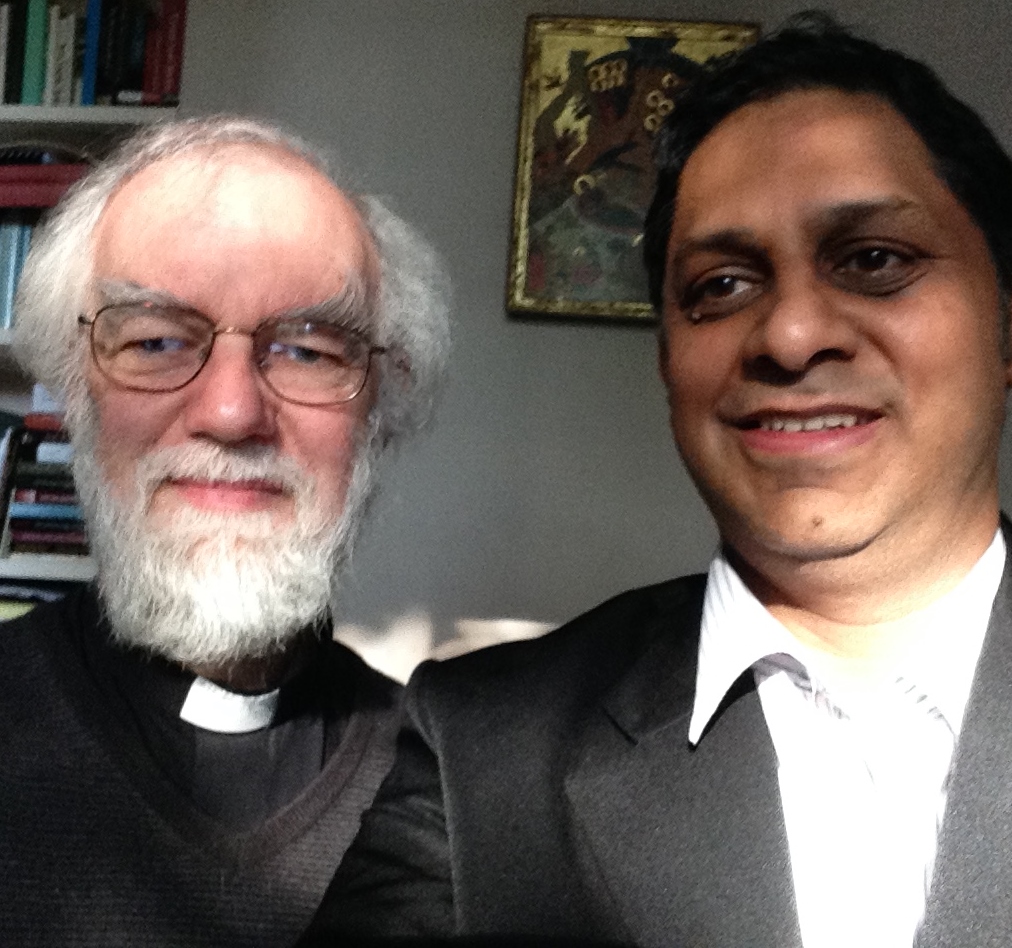
Meeting RowanRowan Williams: I rather share Tim Winter’s doubts about the word ‘spiritual’, as it is so often used simply to designate someone’s feeling of a moment’s significance without posing any questions about the nature of reality or the possibilities of change in society. I understand the word very much against the background of a Christian scriptural use which sees ‘spirit’ as that which connects us to God and one another, that which gives us relation with God and the possibility of life together in peace and justice. Hence the Christian scriptural imagery of the ‘fruits of the spirit’ – the products of God’s indwelling seen as love, joy, peace, patience and so on. To Professor Chomsky’s remarks, I’d respond by saying that the essence of belief in God as I understand it is not belief in values or imperatives but in the actual (though mysterious) presence of an immeasurable agency whose action is directed towards our life and well-being. Such a belief gives me not only assurance but also a sense of being under judgement for my failures to reflect that utterly generous orientation to the Other in my own life and actions.

Musa Askari: “This is not a journey for the feet; the feet bring us only from land to land; nor need you think of coach or ship to carry you away; all this order of things you must set aside and refuse to see: you must close the eyes and call instead upon another vision which is to be waked within you, a vision, the birthright of all, which few turn to see.” (Plotinus – The Enneads)

These words from the great mystic-philosopher Plotinus, introduced to me by my late father-teacher, have long been, along with other things, a cherished part of my spiritual life. Yet perhaps within the inner life of a believer there needs to be awareness of a kind of spiritual complacency. Would you agree to simply memorise a set of words, a prayer perhaps, or even a whole scripture, or the universal declaration of human rights appears to be not enough? How would you advise we guard against at times the familiarity of words we utter from becoming a mask over the reality of what the words are but a signpost toward, “a journey not for the feet”?

Rowan Williams: Plotinus’s words are echoed by those of the great Christian thinker Augustine (who knew Plotinus’s work) when he says that God is ‘more intimate to us than we to ourselves’. God is always nearer than we could imagine. Sometimes we need familiar words to use to remind ourselves of this – I think here of the prayerful recitation of the Names of God or the invocation of the Name of Jesus. If we are careful to punctuate our thinking and speaking with silence, words will begin to recover their original depth. We need always to be aware of our words as ‘nets let down to catch the sea.’

Musa Askari: On universal validity of mystical experience Professor Syed Hasan Askari writes, “There are some who question the universal validity of mystical experience as an expression of one universal ultimate reality. But we do not normally question the universal presence of life, beauty and love which inspire diverse forms of art, music, song and poetry. Nor do we normally question the universal presence of intellect which is the common foundation of different and conflicting theories of science and philosophy. But why is it that as soon as we refer to the universal validity of mystical experience people leap upon us from all sides insisting that mystical experience is subjective experience determined by one’s culture, theology, and personal psychological history. In every other case they seem to remain unperturbed by the co-presence of the objective and the subjective, the universal and the particular – as, for example, in regard to the human body, where there is one objective science of human anatomy and physiology upon which the entirety of medical science is based, and yet there are individual variations as to the state of health and nature of sickness. It is obvious then that the tendency to object to mystical experience’s claim of its inherent universal validity is influenced by a bias that if it is conceded, the next step would be to admit that there is a universally objective source of religious revelations. The objection is motivated by unphilosophical reasons. But it does not mean, however, that all mystical experiences are valid, and that there are no influences from the subject’s milieu and psychic constitution towards the experienced mystical state.”

I would be grateful if you could share your thoughts in response to the above quote on “mystical experience”. How has your inner life been influenced by the presence of more than one religious witness in the world? Is it easier to encounter the other socio-religiously, almost inevitable, even involuntary given the instant nature of global communications? However, to encounter our spiritual neighbour perhaps involves invoking another kinship. One laid out for example in the great mystical challenge of the Sermon on the Mount. Therefore, how do we recognise each other as not only culturally-religiously co-present, upholding all the wondrous diversity, but also spiritually mystically deeply significant to one another, transformative?

Rowan Williams: The idea of universal recognition is crucial here: we see in one another something of the same desire, the same journey, the same drawing onwards – and if we truly believe that our humanity is one at the end of the day, then this is hardly surprising. So I don’t find difficulty in learning from the spiritual explorations of those who do not share my exact convictions. Of course my prayer and understanding depend to a degree on where and who I am and what specific beliefs I hold; I’m not in favour of any attempt to construct a universal system above and beyond the particular religious traditions. But I also think that the more securely you are rooted in your own tradition, the more hospitable you will be to the deepest life in other places. You will see the other, in their otherness, as a gift to you for your growth and maturation.

Musa Askari: I would like to turn now to issues with respect to revelatory communication, the scientific age and quest for alternatives. First, some context by way of the following selection of quotes from Professor Syed Hasan Askari (Discourse on Soul, from Towards A Spiritual Humanism, 1991).

“Let us begin with those people who went through a cataclysmic experience which altered their own self-understanding and which they identified as revelation, as an experience transcending their empirical or functional self. For them, and also for those who said “Yes” to that experience and who entered in to discipleship with such people, and for those who were more reflective in their understanding, the central question was: how could the human mind or the human self become a receptacle, or a vehicle or recipient of an experience, of a revelation, of a transcendental communication – unless, between the source of communication and the recipient there is a common link. Unless there is such an ontological parity between one who communicates and one who receives, the communication will not be obtainable…….It is this problem which was at the heart of the controversy between philosophers and theologians. Izutsu, the Japanese philosopher and an expert in the semantic analysis of the Qur’an, suggests in his analysis of the Quranic discourse that unless there is an ontological parity between the two partners in communication, communication is impossible…….whether you take St. Augustine or Immanuel Kant, you have the same thrust, the same emphasis about the mystery of the human recipient…….Taking hints and clues from medieval insights based upon the edifice of knowledge we have accumulated, I am striving to formulate an alternate anthropology, a substantial alternative to Darwin, Marx and Freud. We have to ask if the anthropology we have held as sacred in modern times is the whole truth or is it not already a dogma. A dogma perhaps more dangerous than the dogmatics of the ancients and medieval peoples because, at that time at least, the conflict between theology and philosophy and between theology and mysticism was very sharp. In our times, the dogmatics of a scientific understanding of man has swept across the whole world and there appears to be no rival to it. Moreover, whoever tries to rival it is considered as either pseudo-scientific or not to be taken seriously at all. Heretics in the past enjoyed a certain prestige, and they became in posterity the great pioneers of human thought. Does the scientific age of our times allow our heretics to become future founders of thought? I am doubtful.” (Syed Hasan Askari)

I welcome your thoughts in reply to the above quotes. In particular do you support revival of the classical discourse on soul as a means to help explain not only revelatory communication between the Supremely meta-physical (Beyond Being, The One/The Good as Plotinus refers) and the material aspect of a human being but also communication between individuals in our everyday lives? That the principle of “Soul” (non-material, indivisible, invisible companion, one-many all at once) is the ontological parity. And finally what do you see as the great opportunities before us for meaningful, mutually respectful, engagement/dialogue between religion/spirituality and humanism? Can we start to talk about what Hasan Askari advocated, a move towards a Spiritual Humanism?

Rowan Williams:  Hasan Askari is absolutely correct in saying that a proper account of our relation with the Infinite God requires us to see ourselves differently. The Christian teacher Gregory of Nyssa in the fourth century CE says that if we understand that we cannot ever come to the end of understanding God, neither can we come to an end of understanding the human person. So we must always approach the human person with absolute reverence – this human individual is a reality we shall never completely contain, control, explain, reduce, and so we have an endless task before us, which is loving and serving them, not explaining them! And for religious believers, there is therefore a close connection between recognizing the infinite mystery of God and reverencing humanity properly. Lose the one and you will sooner or later lose the other. Humanism in the fullest sense requires an acknowledgement of God. A ‘soulless’ humanity, understood simply in terms of mechanical processes, does not have any obvious claim on our kindness, our service, our veneration. We may not be able to say with complete clarity what we mean by the word ‘soul’, but we know that it stands for our capacity to be in relation with God, and thus for all that belongs with our freedom and dignity.

(Many thanks to Dr. Rowan Williams for his kind permission on use of above photo)

Rowan Williams on Dostoevsky

https://youtu.be/Dsswa-CFJhs?si=0-bhSexacC9a4C73

https://youtu.be/CsCQDQHXbWw?si=sj9qQfUPE4Z7JNXR

Spiritual Humanism

Weapons Without Boundaries : a spiritual – humanist response to terrorism

by Musa Askari

originally published in InterReligious Insight – July 2012

img007 If we are going to address ourselves to the issue of terrorism let us state the obvious and most important at the outset: the threat of nuclear weapons. The weapon announced its arrival to the world by unleashing its horror over Hiroshima and Nagasaki, stayed within our collective consciousness during the cold war and now, due to the one-sided debate on group terrorism, faded into the background. But it remains nonetheless real. It is impossible to comprehend fully the potential horror of such a weapon unleashing terror across the planet faster than any virus mutating across national boundaries.

The weapon and its fallout, like a virus, ignore national boundaries, recognising neither friend nor foe, neither oppressor nor oppressed. It does not discriminate. It is non-ideological. The hypnotic pull of the weapon is in the illusion of power it offers those in possession of it. Furthermore, the hypnosis is so far reaching we remain reluctant to be rid of it. The ultimate paradox is that we are protecting ourselves by sustaining a weapon which holds within its capability the destruction of its creator, humanity itself.

A call from the Russell-Einstein Manifesto can be understood as a call to humanity to wake up from the spell of collective hypnosis:

“We are speaking on this occasion, not as members of this or that nation, continent, or creed, but as human beings, members of the species Man (sic), whose continued existence is in doubt.”

The threat to humanity’s continued existence from weapons of mass destruction, stated by Russell-Einstein, is the canopy of “terror” under which humanity has been conducting its affairs for the last seventy years or so. It is a threat that has become embedded in our consciousness to such an extent that it assumes fantastical and mythical proportions. As Hasan Askari puts it: “After all, what is a myth? A myth is a public dream. What is a dream? A dream is a private myth.” It is a dream one remembers dreaming but cannot recall the details fully upon awaking.

More immediate and urgent than ecological concerns, if not on a par with them, humanity needs to be free from the terror of all weapons of mass destruction, nuclear, chemical and biological. To fulfil this extra-ordinary call, heeding the warning of Russell-Einstein, we need an equally extra-ordinary response of freeing ourselves from the grip of collective hypnosis. Unless we give up the old habit that by violence one can defeat violence we may not be able to save any innocent child’s life, born or unborn, now or years from now.

The nuclear weapon has no loyalty to either democratic or totalitarian nations. Is it not utterly shocking that the human intellect which unlocked the science to create such a weapon has resulted, through its proliferation, in creating a situation where the weapon can now destroy its creator? If this is not hypnosis then what is hypnosis? This is the unconscious terror under which we live and dare not look in the face: to behave in such ways where we believe we have freedom of choice when in reality our choices are governed by hypnosis.

To refer to Einstein once more: “God doesn’t play dice with the world.” We may now add: humanity does indeed play dice. What dangerous game of chance is it where the bet being waged is the continued existence of humanity? Whether one describes oneself as spiritual or a secular humanist, what is the value of that spirituality and humanism when such a weapon exists and we do not address ourselves to it? On this greatest of questions for human survival we require a combined, wholehearted, sustained spiritual-humanist response. When we talk of terrorism should it not be a minimum requirement to talk about the greatest threat humanity faces?

The real achievement of collective hypnosis is in its being hidden from our consciousness; by denying its own existence it continues to exist. At least a stage hypnotist asks for consent from an audience and removes the hypnosis at the end of the act. Collective hypnosis, on the other hand, neither asks for permission nor considers removing its influence. Let me cite again Hasan Askari:

“When I spoke in India after the atomic bombs were dropped over Nagasaki and Hiroshima, I said then (1950) that the ideology was dead, the weapon had surpassed it all. A quarter million people were destroyed in a couple of minutes. Man had acted against his own survival. Oppenheimer, the architect of the first nuclear device, while watching the mushroom cloud, had shouted that he had become the destroyer of the world. He then spoke on behalf of those governments of the world who could go on producing more and more deadly weapons, thinking that these weapons would give security and peace to the nations of the world. The irony is that the very ideological division in whose context the weapon was invented had vanished. But the weapon remains. The knowledge that produced it remains. Its potential users are all there. All these years I have waited for that idea that will surpass the weapon of mass destruction and the philosophy and the technology that produced it and that dark psyche which may use it. Hence, whichever ideology claims to meet the challenges of the world at this critical hour must call upon all mankind to rise to abolish weapons of mass destruction and abolish war altogether and every violent means to achieve any national or ideological ends. We then require a total commitment to honour and uphold each individual life. We have limitless resources within our soul to repel evil by the good, repel violence with non-violent means knowing that the truth has its own might to defend and protect itself.”

On one level the general debate seems fundamentally flawed, reduced to questions of power and control. On the one hand, it lends itself easily to rightly denouncing acts of violence carried out by interest groups, while on the other hand it is inconsistent in that equal attention is not paid to similar, if not worse, acts of aggression and violence linked to conflicts past and present by those in political power. A life lost is a life lost despite the ideology that inspires the act of violence. A life lost from either a suicide attack or a guided missile launched from thousands of feet is a precious life. At both ends of the spectrum of violence there is a person, family, neighbourhood, a child, hopes and aspirations. Thus any discussion of terrorism which does not look at the greater issue, loss of human life from any form of violence, is bound to fail due to its one-sided character, and this in turn perpetuates illusions, self- righteousness and collective hypnosis.

(The United Nations and security in a nuclear-weapon-free world)

SPIRITUAL CRITIQUE REQUIRED

A noticeable omission, so it appears to me, in the general news media is we are yet to be presented with some meaningful insight into the thinking of individuals, charged with or suspected of allegedly trying to commit horrific acts of violence. There is much news and information on movement between countries, occupations, academic backgrounds, other general details and so forth. One may track, locate and stop those who are committed to doing something deadly serious. However, beyond this physical security-led approach an attempt to present a spiritual critique becomes relevant when we come to religiously inspired group terrorism.

We may never know the inner psychological make up of each individual case. What we do know is that so-called religiously inspired terrorists, of whatever collective religion and political persuasion, present themselves as people of faith and that opens up the possibility of a spiritual response which both secular and faith-based humanists should be able to make together. Humanists cannot afford to wait on the sidelines and not participate in a joint spiritual-humanist critique of terror acts. A rationalist critique only of organised religion from humanists will not do. The time to revisit that is later.

We require a spiritual-humanist response addressed to the individual committed to acts of violence. The focus of our attention in any response must have at its heart the individual who would carry out a devastatingly merciless act of violence. If that means humanists and religious people need to go down the path of inquiring about spirituality together, so be it. It is in the individual where the hypnosis of terror takes hold, as it tempts individuals (and consequently nations) to respond to violent acts of terror with ever more violence, believing that “terror” has a physical locality – that if it is defeated by physical means in one place it will be defeated in every place. Let us admit that once and for all such an approach is absurd. We should have listened more attentively to those who were advocating an alternative to ever more violent responses to terrorism.

It is a trap we have fallen into it and tragically so many individual lives have been lost – individuals who make up a neighbourhood, city and country going about their daily lives. Whether it was Hiroshima or Nagasaki, Vietnam or Cambodia, Sri Lanka or Palestine, Chile or apartheid South Africa, Afghanistan or Iraq – a suicide attack by a Kamikaze pilot or a bomb exploding in some busy street – who can deny that in every instance the loss of individual lives is tragic beyond measure?

INDIVIDUAL GRIEF

It is individuals related by family or friendship who are left to suffer tremendous sorrow and heartache. They cope in their own way, with immense courage, to somehow carry the grief of their loss. As individuals we suffer, as individuals we grieve, as individuals we hope to rise again above the waterline of trauma and re-gather the shattered pieces of our lives, never forgetting to honour those who have been taken from us prematurely. Should we notice the grief and hear the testimony of mourners we are humbled. Should we hear one story of heartache surely we must also recognise and pay tribute to all such stories across the world, regardless of circumstance, political grievance, national and religious boundaries.

Why are we not permitted to hear, in her own traumatised voice, in her own language, the pleas of a mother in Afghanistan cradling her new born child who was alive only moments ago and now is no more? Why do our news media, for example, seem to insist in having an intermediary to that grief by placing their reporter on the television screen between the victim and ourselves? Who other could do justice to that grief but the grief-stricken themselves?

PURPOSE

I am reminded of the 2011 January 25th protests in Egypt where a man turns to the camera with his mouth bloodied saying: “Here is blood, there is terrorism”. Behind him on that night in Cairo we see crowds rushing for safety at the advance of security forces while the sound of gunshots can be heard. It is frightening watching it and one can only wonder what it must be like to have been there. What shall we say of any purpose behind violent acts of aggression by terrorist groups or states?

By “purpose” I imply something greater, universal, a goal to which every member of the human race can feel akin. A purpose which recognises that humanity’s past, present and future is both secular and sacred. Such a purpose excludes all forms of violence. A purpose which is a conscious self-thinking act by humanity. This to me is a purpose worth striving for in all peace. This to me is for the “common good”. What could be more common between each and every human being than “life” itself? What further good between us could there be than to honour the life of each and every self? Why should we not take a new direction and outdo one another in ever more greater acts of kindness, compassion and generosity upholding the common good, the principle of life?

SPIRITUAL SELF-PERCEPTION

With regard to so-called religiously inspired terror acts I would suggest that what is required is the shattering of religious self-righteousness. If one believes in a merciful and compassionate God, the Lord of “heaven and earth”, then is the mercy and compassion which characterises that Lordship to be understood as limited to a particular religion, region or piece of land, or is it not properly to be understood as universally transcending all divisions which we have created between us? We may need to take into account not only how a person perceives themselves socio-religiously but also “spiritually” – through what I would term “spiritual self-perception”.

By considering individual spiritual self-perception, asking questions about it, by altering the direction of our inquiry, we may yet steer a course away from a troubling development – a development which is another trap of collective hypnosis – that is, identifying the whole terrorist motivation of a small group of religiously motivated individuals with all of the followers of that religion worldwide. By doing so we do an injustice and miss the individual altogether, amplifying the effects of the physical horror, converting it into a general social suspicion of a faith body. Spiritual self-perception is a means to avoid all such developments, keeping our focus on the individual, thereby saving us from demonizing the other.

The ultimate responsibility for an act of terror cannot lie anywhere else but with the individual who commits it. Not a community, not a collective identity but simply and clearly the individual in sharp focus. An individual is more than a representational mix of collective identities. Let us not fall in to the trap laid by collective hypnosis of collective recrimination, isolating communities from each other.

The act has an actor. The script and stage may be controlled and set by others in power (groups/states). However, we cannot deny that the actor, as an individual, still has a choice to play the part or not. The sniper hiding in the rubble and the suicide bomber, both as individuals, have a choice to withdraw from the act. The choice, if it comes at all, may come very late, perhaps only moments before the act, or build up within the conscience of the individual. It is there, within the individual, that the sharp edge of terror, entering the world in a physical form, is born. It is to that moment of individuality that a narrative of spiritual self-perception attempts to speak to. How shall we speak to that individual?

Let us “speak” to that mind-set not just socially, morally, legally but also spiritually. Let us “ask” that individual to see others as individuals and think again.

It would be a mistake in my view, when preserving life is the prime motive, to neglect the question, “what is the individual spiritual self-perception foundation  of any religiously motivated act of violence?” There should be no substantive objection to the word “spiritual” when we are attempting to use it in terms of preventing life from being taken prematurely. The value of the word is not whether a secularist agrees with the concept of spirituality or not. The value is in the potential for presenting a critique to religiously inspired terror – a critique which both secular and faith-based humanists should be able to make independently or together.

Why should there be any objection to the word “spiritual”? Why should we not together bring to bear the whole of human experience (secular, religious, scientific, mystical and spiritual) on problems? As one could say to any religious extremist, “do you worship your religion as a god or do you worship God?”, so one could ask a secular humanist who objects to the word spiritual, “which is more important; your world view or saving Life?” We cannot afford the luxury of conflict between secular, religious and spiritual outlooks when trying to pursue all peaceful avenues for preserving life.

The individuality of the individual, however submerged and drowned out by collective identities, still remains; perhaps latent but not absent. Otherwise how can one seek to explain the phenomenon of those who were once terrorists but speak now against the dogma they once believed, unless they had come to assert some form of individuality? That trace of individuality can also be noticed when we learn of soldiers who are or have been conscientious objectors and refuse to serve any longer. Quoting Hasan Askari, “unless one becomes a universal being one remains below humanity.”

In the arena of universal individuality we may have a chance to appeal to those more valued principles shared by much of everyday humanity. Rebel against that foisted identity and come out of that collective hypnosis which sees violent reprisals as the only effective means. The focus of this reflection is on honouring the most universal of things, individual human life and the common good. For that principle of life to be universal it must sit outside, over and above, all ideology and collective identity.

LIFE

Outwardly, to “love thy neighbour” may be understood as to love that other who bears no resemblance to one’s collective identity of nationality, creed, language, race or religion. However, before the outer comes the inner. Before a thought there comes the thinker of that thought, the individual. Therefore, on the inner plane, there is another “neighbour” who both secular and faith-based humanists could have no disagreement about. It is a neighbour we take for granted far too often. Only when it has moved from its proximity to ourselves do we notice its absence. We abuse it, terrorise and torture it. We pay lip service to it and do not value it universally. It is all about us, it is all within us. Without this neighbour even our negligence of it is not possible. We raise countless tributes to it openly, only to betray it in secret. We honour it at one moment and in one place, at the same moment in a different place we dishonour. Through it all, throughout millennia, throughout all the wars humanity has conducted it has remained by our side. It has remained our constant companion even when we did not give it due recognition.

Who is this “neighbour” which has every right to seek justice for every injustice? It is simply and wonderfully, Life! From the sunrise of humanity to its sunset, each day, each night it is Life that is our nearest and dearest, our true next of kin. It is a kinship that bonds us to each and every human being on the planet. What a wondrous kinship it is indeed where it breathes through all outer kinships, through all divisions, through all diversity; it is the unity that binds us to each other. It is the Life of Humanity. As my late father used to say, “just reflect on the word Life!” I ask anyone contemplating any act of terror toward their fellow human beings to reflect on the word Life!

To repeat: as individuals we are more than any personal or collective identity; we are more than a nationality, creed, race or ethnicity, religion, caste or sect. May I suggest as humanists we cling to our identities lightly but not tightly: that such identities may inform our thinking but it is not essentially who we are. Spiritually, I would suggest we cling to such identities lightly with the hope that eventually we may let go of them so that what remains is the undivided individual. One un-differentiated self.

Nameless, we are born from our mother’s womb, unique and mysterious. In an attempt to identify that mystery, we are named. Perhaps this is one of the reasons why it is a moving experience when the names of those who have died are read aloud at remembrance gatherings throughout the world. How many names are forgotten? How many children have perished in acts of violence? Let us pay tribute to that mystery of life universally so that when we remember the innocent victims of one attack in one place we remember all such victims in all places, from people living under oppression to those in so-called free societies.

When we claim our individuality do we really mean it? Or do we think of ourselves as individual representations of a collective identity. That individual representation can become, under the spell of collective hypnosis, very easy to ridicule and dehumanise. We have seen it in the past, we are seeing it now. When one stops “seeing” the other as an individual another kind of birth mentally has taken place: the birth of the oppressor.

Where pride in collective identities, in extreme cases, takes on an exclusive one-sided face there we are entering a hypnosis which, in preservation of that identity, can readily ignore the injustices inflicted upon others. A self conscious good takes hold. In preserving any collective life by oppressive means, psychological and physical, it begs the question: where is the individual when gripped by collective hypnosis? Quoting Hasan Askari again:

“Jung was critical of world events, and he put forward the notion of the collective consciousness or the collective hypnosis created by religion, race, culture and language. In that sense, I believe that what Freud calls illusion, what Marx calls the opium of the masses, what Durkheim calls collective representation, and what Jung calls collective hypnosis, all sum up the phenomenon of collective history restricted to one particular formulation.”

In recent times one of the most powerful symbols of individual non-violent responses to terror has been the image of “The Tank Man” from Tiananmen Square; a lone citizen making an unarmed stand against the march of tanks. The footage is deeply moving. A lone man standing in the middle of a boulevard, straight, still and defiant. No weapon, just his individuality. Outwardly on one side there is the “Tank Man”, alone. On the other side there is a line of tanks, a symbol of state military power. Inwardly, what in my opinion is also spiritual, the “Tank Man” has a far greater number standing behind him and beside him. They are invisible to the naked eye. They are to be found in every age and culture and in every place where people live under oppression and terror. They are the “individuals”.

We should recall there were two “Tank Men” that day. One standing before the tank and the other hidden from view driving the lead tank. What transpired between those two individuals staring at each other on that afternoon we will never know. What was he saying? Who was he? It is a mystery. At least this image is known. What of the unreported and ignored lives of those equally brave individuals standing up peacefully to terror and oppression all across the world? We saw them and we heard them during 2011 in what has become known as the Arab Spring. They continue their struggle.

The recognition of suffering and grief in order to be a true recognition must, as a consequence, involve the recognition of suffering and grief of all people everywhere. The people concerned cannot look the other way. One can only imagine what immense heartache they undergo and even after such imagining and empathy there is still perhaps an abysmal gulf between our imagination and their reality. A spiritual-humanist response to all forms of terrorism starts not in the world out there but instead within the heart and mind of each individual. To quote Hasan Askari:

“In my view, there should be a two-fold response to idealistic and ideological developments which result in self-complacency or collective hypnosis. First is a sociological response which helps people or the communities involved in knowing why a particular idealism / ideological formulation is becoming relevant to people at one time in history. The sociological critique would liberate us from a collective hypnosis and lead us into an objective self-understanding.”

“The second corrective is, in my view, a psychological critique that this one-sidedness has far reaching consequences for the human personality because here its humanity will be deformed, will be partialised, will be fragmented. In order to create a synthesis of the sociological and the psychological critiques we have to enshrine in our understanding and in our reflection another category, not just of attitude, but also the very characteristic of the truth we are seeking, namely openness, or willingness to listen to the other in his or her otherness.”

A Spiritual-Humanist response to all forms of terror, as well as being a questioning of power, oppression, violence and war, is also a journey to seek the truth of our inter-connections as individuals. It will be a multi-faceted journey with many co-travellers: secular and faith based humanists being co-present recognising one another, bearing co-witness for the mutual goal of preserving and valuing LIFE in all its diverse and wondrous manifestations. The best among them being the Life of a child who expects the world to save it from the worst of what humanity has done in the past and who hopes for a different future.

CONCLUSION

Finally, concluding these, admittedly broad, reflections let me re-state the greatest threat to human survival: the nuclear weapon, which, in my view, is a crime against every single living individual human being. As we worry rightly about handing over to future generations the problems of ecological disaster, let us not also hand over to a future humanity an inheritance which includes the terror of weapons of mass destruction. The taking of any life anywhere, regardless of who comes to know about it, through any form of terror act, is a crime against the whole “single cell” of humanity. A humanity richly diverse is a wonder and mystery – secular and religious, material and spiritual, physical and meta-physical. As Hasan Askari put it, humanity “stands for a hidden, universal unity across all physical and racial boundaries.”

See also

Human Nature by Hasan Askari  

Spiritual Humanism speech by Hasan Askari, 1995

Ideological Dogmatism by Hasan Askari

From Inter Religious Dialogue to Spiritual Humanism by Hasan Askari

“Bulletin of Atomic Scientists”

Article VI – NPT Treaty “Each of the Parties to the Treaty undertakes to pursue negotiations in good faith on effective measures relating to cessation of the nuclear arms race at an early date and to nuclear disarmament, and on a treaty on general and complete disarmament under strict and effective international control.”

http://www.interreligiousinsight.org/bedlam_code/data/2012-07_a4.pdf

Inside the Centre: The Life of J. Robert Oppenheimer by Ray Monk (review via London Review of Books)

“One of a Kind Soul – Hasan Askari” by Candice Rowland

Candice Rowland  http://fruition2012.wordpress.com/ is an aspiring author on a spiritual journey. Her passion is to HELP others someway, somehow. She cannot say she is religious but religious about all faiths. Candice BELIEVES there is a God with a mighty purpose for all of us to follow. Candice hopes all can listen within to our tiny voice, “If we silence ourselves, God is whispering to us all the time. If we listen long enough we will find our true purpose in life. Anything is possible if you are pure and true in mind, heart, body, and soul.” Candice’s faith resides in Love and Peace. “When one’s soul has found LOVE within oneself, one has found God. When one has found GOD with LOVE peace and tranquility assumes their being. When peace and tranquility begins with one soul, this will transpire to another soul and another and so on.”

“One of a Kind Soul – Hasan Askari” by Candice Rowland

“We have first to wake up from the spell which our collective identity, whether it be of race or of religion has cast upon us, and see the sun of awareness rising in the horizon of our souls, in whose light the hidden grace in each one of us would become visible to the other. As we bow to each other as soul beings, we bow before God who is both in us and above us. What can then prevent us from saying to each other that my soul and your soul is one soul, that our God and your God is one God? We shall then abolish fear, and then our greeting of peace will be a perfect greeting!” Hasan Askari http://www.interreligiousinsight.org/January2004/Jan04Askari.html

Reading Hasan’s words above gives me goose bumps within my own soul every time I read them; how divine his words resonate with souls on a spiritual journey such as mine as yours. His connection with the religious diversity is far beyond wisdom; it was part of his true being to bring all faiths to an interfaith dialogue to speak, to converse with one another of one another’s religious beliefs; to bring understanding within one’s soul to another soul.  As Hasan states, “Our coming together in dialogue becomes akin to an act of worship; our exclusive witness is transformed into co-witness; our one-way mission is replaced by mutual mission.” 

The one thing Hasan believed man had forgotten which has brought much suffering in the world, forgetting the Supreme (God), and the soul. “The loss of a sense of transcendence from our consciousness, and the accompanying loss of the gnosis of soul, have led first to the degeneration of religion and eventually to the despiritualisation of politics and science.”     

Hasan was a man with a mission to somehow, someway to spark awareness in mankind to transcend him back to God and to “our nobler and loftier companion, our Soul.” Hasan directly points out, “First soul, then God! The soul possesses the vision of the Supreme One.” He proceeds to say further in his article, “First one must “Know thyself” (written on Gate of Entrance to the ancient Temple of Delphi) and “Whoever knows his self knows his Lord” (said by the Prophet of Islam).

As Hasan expresses adamantly, “Soul is one and many, a universal being. It is in souls of each other that we encounter each other both individually and universally. We surpass the boundaries of our outer identity.”  In other words, we must as spiritual beings find within ourselves, our soul then only then can we move to find God. And when we unite with the soul we find God; then can we see our soul reflected in other souls with different religious backgrounds, race and culture because the soul is universal as so is our God, all is one; we are one.

One quote always remained in my memory from Hasan and this is why I chose this article in particular to try to bring clarity to myself and others on a spiritual journey. It is this, “A real evangelist would be one who brings the good news of universal truths as these are glimpsed through various religious symbols and philosophies.” This rang with vibration within my soul when I read this because if we all could speak of universal truth and not just what we collectively identify with in our culture, this would bring a sort of peace to mankind. Why? As Hasan says: “Our perspectives will expand: we shall not only notice religious diversity as a spatial fact but also value the coming and going through time of teachers and prophets, religions followed by religions – all calling upon us to wake up and humbly bow in self-knowledge before the almighty source of our souls. Then our conversion will be not to this or that religion but to one God (speaking theistically), All Transcendent-All near, All Freedom-Ever New!” How beautiful Hasan wrote this; brings tears to my eyes.

Not only did Hasan write scholarly, spiritual inclined papers with answers to beyond difficult questions one must answer to bring peace to Earth and unity of mankind, but he wrote poetic articles. As such, the “Seven Mirrors.”  https://spiritualhuman.wordpress.com/2012/02/19/seven-mirrors-by-hasan-askari/

Reflecting his vision during silence of one candle; reflecting in seven mirrors reflecting seven candles. He then through thought realized, “If the original candle stands for the eternal presence of the Light of God, all its reflections too were eternally present before it. For God there is neither before nor after, neither past not future, but one eternal present, not like our present but a time that includes without division all times.”

And lastly, Hasan’s heartfelt story, “The Rebirth Through My Son.” https://spiritualhuman.wordpress.com/2011/04/25/rebirth-through-my-son-by-hasan-askari/

This is about a father’s journey through his life while in search of meaning knowing the pain and misery he caused to himself and his family.

But his youngest son never gave up on his father. He visited his father because of a bond he could not help from feeling to his father and the longing to want to know more of him. Finally one day the son asked him a question that stirred him within.It was that evening that all of a sudden he felt that he was renewed deep from within. His son’s remark had demolished his shyness before his son. He felt that they were now brothers.”

And so how Hasan ends the story with a story to his son, “Once a visitor called and said to his father, “I have come to see your son. May I know where he is?” His father replied: “Do not call him my son. I am his son!” How this says it all between Hasan and his son, Musa.

Now this brings me to the end, to Hasan’s son Musa. If was not for Musa I would not have had the beautiful experience of reading Hasan’s work. And because of Hasan’s works it has brought me to a new but reviving view of my spiritual journey.

Hasan, I can only say you are a precious soul for other souls to follow in your footsteps but that would not be right, as you would say, “This is not a journey for the feet; the feet bring us only from land to land; nor need you think of coach or ship to carry you away; all this order of things you must set aside and refuse to see: you must close the eyes and call instead upon another vision which is to be waked within you, a vision, the birthright of all, which few turn to see. (PLOTINUS – The Enneads, 1.6 “On Beauty”)

On this day February 19th, a very special day, I can only say Hasan would be so very proud of his son, Musa. To keep his work alive through his continuing relentless effort or shall I had said “effortless” for Musa. I thank you Hasan for your work; and your loyal son and your best friend, Musa. God Bless both of your souls.

I have only mentioned a couple of Hasan’s articles that resonated with me, but how all of his articles and works are a tremendous awakening for all to read. I encourage you to read them all.

Namaste, Shalom, Salam, Peace,

Candice Rowland

“Reflections on the Prayer of St Francis of Assisi” by Musa Askari

“Reflections on the Prayer of St Francis of Assisi” by Musa Askari

“Lord, make me an instrument of your peace.
Where there is hatred, let me sow love;
where there is injury,pardon;
where there is doubt, faith;
where there is despair, hope;
where there is darkness, light;
and where there is sadness, joy.

O Divine Master, grant that I may not so much seek
to be consoled as to console;
to be understood as to understand;
to be loved as to love.
For it is in giving that we receive;
it is in pardoning that we are pardoned;
and it is in dying that we are born to eternal life. Amen”

It was my late father, Syed Hasan Askari, who introduced me to the prayer of St Francis many years ago. My introduction came in the form of hearing it read aloud. Perhaps to come to a new prayer not by reading it first but by hearing it one is somehow  able to let the prayer rest more gently upon one’s soul. Especially if hearing it read by a person one trusts. Therefore, prayer may also be understood not only as a sign of devotion but also trust between seekers of truth and greater still a sign of Trust in a Higher Power to which the prayer is directed.  

To hear such words of love and devotion for the first time resonated very deeply. In the years to follow the prayer would become one among many of my constant sources of inner support. I would not only read it in silence or remember it during the course of a day but moreso I would make a point of reciting it by whispering it to myself at some late hour of the night. Through this whispering recital the prayer became more real, an experience, not only of emotional support but far beyond that to moments of  experiencing the prayer as a form of being itself. That it almost had a life of its own. A life in which I was hoping to participate if only momentarily due to varying levels of inner intention and alterness.

Over and above the actual form, order and beauty of the words it is worth exploring, if only superficially through this reflection, the manner in which the prayer is working upon our inner being. What is its outer effect and what is its inner influence? What kind of inner preparation is required to utter such words as authentically as possible? If one is an “instrument” it begs the question who is the invisible artist and what is the melody that is being played? In what way, if at all, do the first and second verses talk to one another? Does a prayer stop when we have finished uttering its words of devotion and praise? Or is there a life, above our own embodied life, in which the prayer perpetually participates? Are prayers, in the form presented to us by inspired individuals who first uttered them, an echo of a far greater recital of praise and devotion that goes on above our consciousness?

Where there is an echo there must be a source from which it emanates. Where there is vibration there must be the beat of a drum. Where there is beauty there must also be the eye which recognises it as such. Where there is thought there must a thinker. And where there is a question there must be a clue or the answer complete. Is there such a question and answer present within the prayer of St. Francis? Is there any such dialogue implied between the one who prays and One to whom the prayer is directed?

At first glance perhaps not. However, if one looks more closely, at the first verse in particular, the following may be a clue where there are six question and answers present and not only that but clear intruction or remedy provided.

Take for example the line, “where there is injury,pardon”. By considering it as three lines a dialogue becomes apparent:

We ask, “Where is injury?”

The prayer answers, “There is injury”

Remedied by, “Pardon.”  

Take another line: “where there is despair, hope”: 

We ask, “Where is despair?”

The prayer answers, “There is despair”

Remedied by, “Hope.”

Is it not so that through most of our heartfelt prayers, either handed down by tradition or uttered by oursevles spontaneously, we somehow feel in “conversation” with the Supreme? It is into such a “conversation” the prayer of St Francis invites us to enter. In other words, consciously or unconsciously, the human soul is in constant “communication” with its Source. A Source from which it emanates and to which it longs to return. It is perhaps this “communication”, this greater dialogue, that the prayer somehow lifts the reciter innerly to become more conscious of. All great prayers take us in this direction. The prayer becomes a door into another kind of awareness.

Prayer, as both dialogue and a form of worship, is a most peculiar kind of dialogue. We are asking questions and we hear only our voice. A voice that may be frail and shaking, through some traumatic experience, or overjoyed with gratitude for what we have been shown or recevied. The answer to our prayers, however, is heard in silence. The Great Silence of The Supreme Presense, the First and the Last. The Hidden and the Manifest, everywhere and yet nowhere, Immanent and Transcendent. I am reminded of the following from an much earlier piece of writing of mine, “It is in such silence that the Divine Command is uttered perhaps”(The Sound of Silence, 1992) https://spiritualhuman.wordpress.com/2011/02/28/the-sound-of-silence/

In our corporeal nature we hear corporeal things. How can the physical ear hear an answer from One who is Supremly immaterial and Beyond Being? Therefore, silence and patience become the means through which our inner ear becomes more atuned and there we may wait, atentive, alert, humble and above all listening by stilling all distraction within our lives, touching the fringes of a greater peace. Hearing as it were by another mode.

In the prayer of St. Francis we have a deeply moving dynamic where not only are question and answer co-present but also the remedy or instruction to the question. The prayer consoles, reassures and embraces all at once. There is no delay in compassion. The remedies of love, pardoning, hope, faith, light and joy are instantly provided as soon as the question and answer are complete. Infact, the prayer does not wait to be asked how one corrects the disorder within and without. It rushes the remedy towards us faster than we inhale our next breath. Life before life.

One may choose simply to reflect or meditate upon only one line of the prayer and be moved beyond measure. The question, “where is despair?” may be asked outwardly addressing the world and we are presented with images of oppression between human beings or come across testimonies of those who continue to suffer and through such images and accounts we are told innerly, “look! there is despair”. All one need do is ask the question wholeheartedly, compassionately and sadly too many answers come flooding to our consciousness of lives lived in despair. The prayer challenges to ask and notice the other and by doing so abolish otherness from our being. One need not look far to see despair if one chooses not to walk by on the other side. On the other hand the same question maybe asked about oneself to oneself, “where is despair?”. Here personal courage is needed, for now we are looking into the face of our lives and should we be able to peer with unwavering inner strenth the answer comes, “there is despair”, directing us to some long forgotten memory or unravelling chains of thought which enslave and cripple us mentally, distancing us from the world and from ourselves.

To both outward and inwardly directed questions on despair the answer is the same, “hope”. In other words, do not despair, there is hope. The very question itself is “hope”. The question carrying within itself its own liberating power. The question is hope “embodied” as a thought. The question cannot come from an abyss of utter want or lack, the question must carry with it the source which sent it on its way. As referred to previously; the prayer consoles, reassures and embraces all at once. It can only do so if it is enveloped by an inspired inspiration. In the outer form of one line, the question and answer go hand and hand, as like two hands coming together in prayer.

Further, the first verse gives us another insight. It offers a definition of “peace”. Of what “peace” means when commencng a recital of the prayer. Here peace is to love. It is also to pardon, to have faith which implies to trust, to be hopeful for the Light of the One to whom the prayer is addressed is neverfailing and our overriding inner state of such peace in that moment is to be joyful.

The prayer of St. Francis begins in the name of peace and that is perhaps why it has survived to this day and recited by so many. The human heart in perpetual quest for peace. If humanity’s “humanity” is to mean anything it must surely begin with peace regardless of it being called sacred or secular. The Russell – Einstein Manifesto (1955) sums it up beautifully, “We appeal as human beings to human beings: Remember your humanity, and forget the rest.”

Would that those who wage war in the name of “peace” remember such qualities of peace as offered by St. Francis. Would that they pause and re-think in “silence” if they truly are bringing peace or the oppositie of peace which the prayer of St. Francis does not shy away from making clear. Namely, hatred, injury, doubt, despair, darkness and sadness.

In my view the first verse is where the inner work is to be done. The first verse prepares the inner ground, turns the soil, so that we may “sow” such seeds as love and hope. Thus making the earth of our being a fertile ground from which may spring, over the ocean of our consciousness, all that the second verse leads us toward. The second verse finally frees us from enslavement to our ego-bound mindlessness. Of collective hypnosis from our exclusive one-sided attitudes to identities of race, ethnicity, culture, creed and ideology (religious or humanist).

We are in a totally new frame not only of mind but consciousness when proceeding through the second verse line by line. When the first verse has “consoled” us, “understood” and “loved” us like a kind friend or beloved. When it has enriched and pardoned us our failings. When we have been transformed within and without through the power of the first verse then, and only then, we may truly mean the words which pass by our lips of surrender from the second verse. We ask nothing for ourselves when we have been given more than could have been asked for. Now, one may recall how the prayer began, “Lord, make me an instrument of your peace”.

Through the discourse on soul we are told body is the instrument of soul, the material is later to the immaterial. Yet, it is not the body which seems to be the “instrument” implied when we notice how the prayer ends, “it is in dying that we are born to eternal life.” What other could it be that perishes, passes away, than body? And what other than soul could we speak of when we speak of life eternal? It is soul that has the right to eternal life. Only soul un-embodied remains immortal. Soul, impartible, invisible, indivisible, non-material companion of our self, both one and many at the same time.

The higher levels of the beautfiul prayer of St. Francis may only be reached when perhaps we consider the prayer to a prayer of the soul. An echo of a greater prayer that continues above our consciousness. What the words of that greater recital may be, only as souls shall we come to know. Soul, here and now.  Peaceful greetings to the soul of St. Francis of Assisi.

I conclude this brief reflection with the words of my teacher:

“Pray that you are granted an unbroken awareness of your higher soul, that which is the authentic principle of your being, that un-embodied, immortal, all pervading reality, which is one and entire everywhere, every time; that which is in perpetual contemplation of the Divinity above it, that which remains separate, apart, above all you do, relate, experience and suffer as a…body here. Remember it, for it is the true source of your peace and power. Remember.” (Hasan Askari, “Pray” from his book “Alone to Alone”)

Originally published as guest article http://soul-licious.com/?p=918 Thank you to Mia Caruso for asking me to write about the Prayer of St Francis.

See also: Prayer for my Parents & O Light of Lights

“The Eternal One” by Lee & Steven Hager

“The Eternal One” by Lee & Steven Hager 

reflection on the work of Hasan Askari

We didn’t have the privilege of meeting Hasan Askari while he walked
this earth, but we have come to know him through his son Musa, and his
abiding spirit that continues to live through his words. As Hasan
himself said, “A book written by a sage is like the residence in which
he still lives.”
We felt especially drawn to Hasan because he was

among those rare seekers who looked both within and then is also able
to look without. He recognized, “Before we ask about the other out
there, we should ask about the other in us, our nobler and loftier
neighbor and companion, Soul.”
But instead of becoming caught up

solely within his personal inner explorations as many do, Hasan turned
his attention to the problems that fill our world. His work speaks of
his heartfelt desire to help others look past the outward religious
dissimilarities that separate us and instead discover the great truths
that unite us all at the core.
 
Enlightenment can be described as an inner awakening that allows us to
see past the illusion of separate forms and realize the Oneness of All
That Is. Hasan wrote, “The life which is multiple and diverse at the
human end is One at the Divine end.”
He was not the first person to

awaken to this truth, and he won’t be the last, but it was extremely
important to him that we all see beyond our humanity and make a
connection at the level of the soul. Hasan recognized that while
religion has often been a huge bone of contention, it can also become
a tool for unity when we understand that all souls are united by the
same eternal truths, and those seeds of truth can be found within
religion when we look past the surface.
 
In the introduction of his translation of “Solomon’s Ring: The Life
and Teachings of a Sufi Master,” Hasan said, “I was looking for a
language which could make dialogue possible and mutually enriching
between people of different religious traditions. I was already free
from sectarian and religious dogmatism…Real speech was for me a
linking of soul with soul.”
Hasan found that language when he

discovered the distinction between belief and faith. He wrote, “While
belief is a part of the cumulative tradition, faith is the personal
immediate possession of each individual by which one relates to one’s
life…faith is thus an inner ability to relate and communicate without
fear”

So much of the world’s self-imposed misery could be avoided if
humanity embraced that understanding. As Hasan recognized, we often
mistakenly cling to the trappings of religion, much as we cling to the
outer trappings and traditions of our national origins, because we
mistakenly believe they define us. In doing so, we fail to ask
ourselves how something that is essentially non-material (the Self or
soul) could be defined by something associated with the material. We
become militant in their defense because we fear being swallowed up
and lost, but as Hasan pointed out, “Love is the harmony into which
all contradictions resolve.”
Love is the glue that holds us in

oneness, but we cannot see it when we’re tied to outward appearance.
But if we dug up several different types of trees and looked only at
the roots, we would find that it’s very difficult to tell them apart.
 
However, as Hasan recognized, opening ourselves to others requires
courage. Hasan’s son Musa relates that we must first recognize that
the ‘other’ is not truly ‘other,’ but “someone from whom one can
learn; that their experience has something deeply meaningful to
offer.” We find this a frightening prospect because, as Musa points
out, we “run the risk of being transformed positively by the witness
and testimony of the other.” Our first challenge, if we wish to see
positive changes in our world, is to stop seeing anyone else as
‘other’ and embrace Oneness.
 
We are surely at a critical time in man’s history. Certainly human
beings have always been at odds, but we have never before had the
capability of ending our arguments by obliterating life as we know it.
If there was ever a time to heed the words of visionaries and
peacemakers like Hasan Askari, it is now. Our differences have not
given us anything of value, our oneness can.
 
Where there is no other, there is no fear. To the extent this
awareness is obscured, fear will rise in the same degree
—Hasan Askari 

____________

Lee & Steven Hager, the authors of “The Beginning of Fearlessness: Quantum Prodigal Son.” Writing about themselves, “We’re just like you. We have no special qualifications, but after years of struggle, we discovered the key to living a life of fearlessness. If we could, you can too.” Please continue reading more about Lee & Steven and their unique journey of living a life of “fearlessness” http://www.thebeginningoffearlessness.com/

See earlier article on this blog by Lee & Steven “That’s Good” https://spiritualhuman.wordpress.com/2011/09/05/thats-good-by-lee-steven-hager/

“Four Breaths” by Hasan Askari

FOUR BREATHS

by Hasan Askari

(Alone to Alone: From Awareness to Vision)

One may concentrate on an idea that connects oneself to the whole of the cosmos and which heightens and deepens one’s self, and at the same time start gently and wholeheartedly breathing within. Which is so important and effective, idea or breathing in, depends upon one’s crucial choice in attention. By accompanying the act of inhaling with attention one touches the fringe of the life of the idea, its universal power and joy.

First however is the breath of purification, of burning away all that is dense and hard, all that is alien.

Second is the breath of returning from the outer limits, from the six directions of front and behind, right and left, above and below, it is a breath of returning to the seventh point, the centre within.

The centre is also the sphere; as a centre it is eternity, and as a sphere it is infinity.

Third is the breath of ascent to one’s archetype remembering that one’s form here below is an image.

The archetype is both the Self and the Cosmos, after the analogy of centre and sphere.

Fourth is the breath of adoration at the appearance of vision before the innerly directed eye, before the thought in rest, stable and gentle.

This discourse has nothing to do with one’s physical and psychological well-being. If one feels physically and psychologically healthy, that is a very minor reward. The relation of the exercise to the life of this world consists in ingathering the positive and helpful forces. The rest, its greater part, lies above consciousness, above the imaging faculty.

However, valuable, whatever be the authority on which they rest, all techniques of self-development in their elaborate rules and details, without the simplicity and willingness to surrender before the Great Work that goes on above our knowledge, are a burden keeping the novice under one illusion after another.

Pay attention to the idea, and hold it invisibly, its wonder and beauty hidden from one’s ordinary sight. Remember how one sows the seed, and hides it, and waits in trust.

Let Forgotten Memories Unfurl by Musa Askari

What is the moment?

When buds turn to flower

When clouds release a shower

When winter releases from its heart spring

Do you ever wonder at such things? 

Have you ever wondered

Why you are here?

And cried a silent secret tear

Have you ever wondered

From where did you begin?

Which mother’s milk did you abandon never tasting? 

Even though you may be trapped and bound

By this world that has let you down

Where are those first footprints to be found? 

Look not for them

In your earliest childhood days of this world

Continue Beyond

Let forgotten memories unfurl.

It was in March 1993 I put together the words as above. I was in my early twenties. It was a time of continued inner expansion. Many things were becoming clear on the direction my life may take. I was not only reading Plotinus (The Enneads) but also hearing my father, Hasan Askari, talk about the great mystic-philosopher, considered the father of Neo-Platonism, who is Soul through and through. I returned again and again to my father’s book “Alone to Alone” which had been published a few years earlier and new meanings came to light. The expansion I refer to was centred about one word, “Soul”: that impartible, invisible, indivisible companion of our self, both one and many at the same time. 

I learned of Plotinus’s term for the Supreme, The One – The Good. I heard about his system which referred to “emanation”. That from The One, who is above all association, emanates The Intellectual Principle, from which comes The Universal Soul and then The Individual Soul. I heard about such terms as conjoint; association of Soul with Body, with Matter. One of the most beautiful things I recall, ever-fresh, was hearing Hasan speak of Plato; that it is not the Soul in Body, but rather it is the Body in Soul. This had a transforming effect upon my thinking, upon my spirituality. It resolved many issues on the relationship between Body and Soul. It opened new doors. And still we had not come yet to ourselves; all this was Soul entire, Soul un-embodied.

It is important I explain a little what I mean by “direction”. I do not mean any worldly direction of occupation or career, of planning one’s life academically or anything of that nature. “Direction” was for me an inner movement which would dictate the outer movements.  I was already a student of my father’s work for many years. The beauty about his manner of teaching lay in that it was never forced. It was simply presented. We engaged in discussion deeply, or I observed him in dialogue with others. I observed him all on his own. And despite many serious challenges in life I witnessed an unfailing dedication to both his work and his inner self-mastery, which was one and the same. It was at moments observing a great artist at work, sculpting, painting or reflecting. 

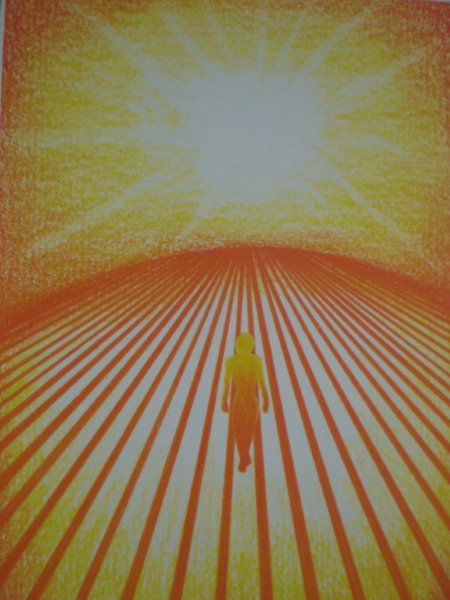
To see his face light up at the dawn of some new idea or unravelling of some mystery was for me like watching a sun rise above the *horizon. The faint advancing light that ushers in the arrival of the actual Sunrise. Ideas used to dawn upon him wherever and whatever he was doing. Either in conversation-encounter with others or all alone sitting in silence. Observing him I was certain of one thing, his mind was never far from the remembrance and praise of God.  One of the greatest lessons I was taught by him was to seek the company of solitude. To seek out time for oneself during the course of the day, to think and reflect, to be still, to pray, to remember The Supreme. It was as if one could spend an entire life time in that silence. The days could have come and gone, the seasons passing as like rushing clouds overhead. The sun could have risen and set countless times, one would never have known. 

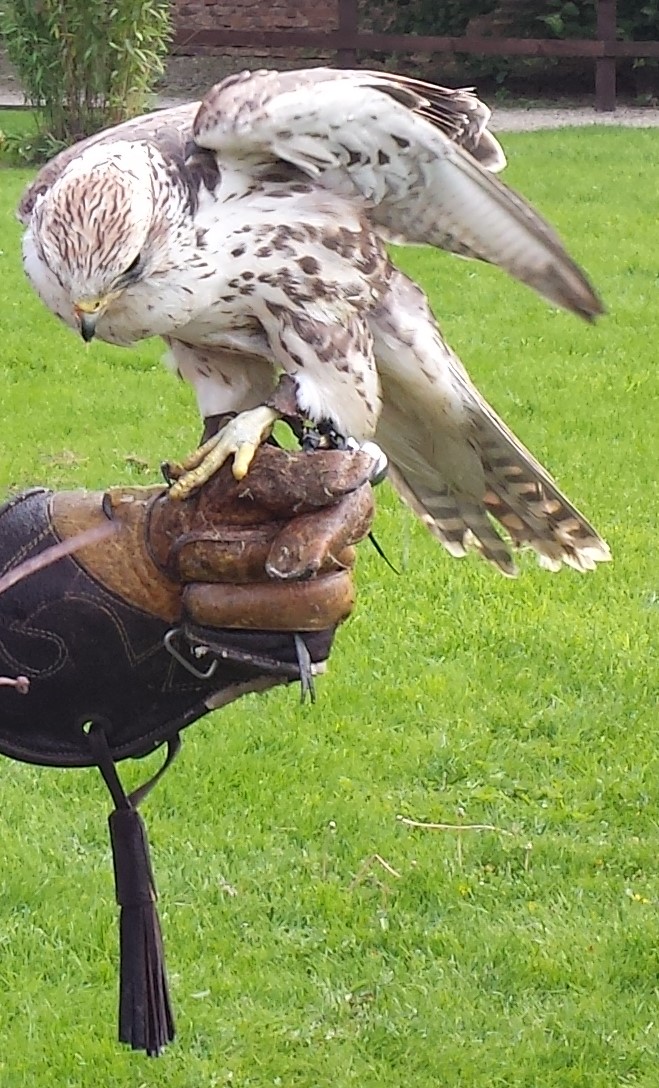
Falcon

I developed the habit early on of waking up and being alone in silence with solitude. It was at one such moment I reached for pen paper and the poem “let forgotten memories unfurl” came about. A thought came to me. I put down the first two lines and it went from there. Ideas, images and ideas behind those images were my torch bearers, they guided me and I followed. Within those moments of the night I was seeking some understanding of soul, something, anything. To move from the discursive to the intuitive and spiritual. To lift the words of my teacher from the page and carry them upon my head as an offering for my Soul to pluck me on flight to some deeper understanding. As like an eagle or falcon plucks some morsel of food not forgetting to return to the “Hand” that released it. Talking and hearing about Soul from Hasan I came to notice the world about me more, the physical world, nature for example.

I reflected on the simple beauty of nature and started contemplating another moment within nature. One moment and yet a multitude of moments. The moment when a bud decides to flower, clouds releasing their shower. It was not that I was seeking an exact temporal timeline, that was not the goal. The goal became to ponder and reflect. To imagine oneself just being present at the very moment one particular bud decided to begin its flowering. It was as if the act of observing and flowering were one act but in different forms. To imagine that which called forth the bud to flower was the same which called one to notice it. Symbolically, one of the ways a flowering bud may be understood is akin to our eyes opening from a deep sleep.

The beauty of a bud is further increased when its petals have opened fully, reaching for the sun much like our own physical eyes more beautiful once open and light hits the optic nerve. Can one bear witness to any physical eye being beautiful in the dark? Whilst closed the beauty of our eyes is concealed, but would we deny, even when closed, that the very “Idea” of an eye is a beautiful thing. An “Idea” of beauty by which other beauties are seen, a hierarchy of Beauty, of Ideal Forms, intangible and immaterial. Now we may invoke the adage, “the eyes are the windows to the Soul”. Sometimes both acts, flowering and observing, are mirrors and the original is out of sight, at others one is the mirror and the other is the original standing before it.  It all depends at which point within the hierarchy one is “standing” as Soul. 

There also comes a point to turn the arrow of inquiry from nature to oneself, from outer to inner. To ask deeply, with meaning, with tears, with a yearning like never before, “why am I here?” Again it was not any conclusive answer I was searching. I was not seeking to unveil some crystal ball and peer in to it becoming so disoriented whereby I lost sight of the very thing that brought me to ponder the question. The power was in the question itself. The question was the guide and that I tried to keep intact. 

In coming back to Soul, on this poem, another idea came to me. Namely, above our memory, a timeline from birth to the present moment. Above all the experiences, all relationships, above all these memories, tragic and joyous, above even our dreams, there is another memory. A more Ancient Memory, that of Soul. Embedded within that memory is a “Call”, a Command almost. A beckoning for the Soul to turn its gaze from looking down at what it has created, forgetting its priors and thus forgetting its own inner memory. A “Call” to become free of being infatuated by its own beauty and seek the home of that Light which shines within it. The Home of Beauty, that from which Beauty emanates.  To look up, as it were, to its Source. Within the Islamic tradition there is a beautiful way of recalling this memory when The Quran reminds, “We are of God and unto God we return”. In other words one’s Soul is from God and unto God it returns. Quoting Hasan Askari from his 1995 speech on Spiritual Humanism, “our journey ultimately is from soul to God. Pure is your soul, purer is your approach to God”. https://spiritualhuman.wordpress.com/speech-hasan-askari-spiritual-humanism/  

We already accept there is a memory in to which we are born. A memory we have no knowledge of as we are born. It is a memory presented to us as integral to our worldly identity, a pseudo-identity I would say, a garment, a covering.  Memory upon memory which over time distances us from a far more Ancient Memory within the Soul having the potential to distance us from one another. Namely, in general terms, our collective identities of race, ethnicity, nationality, gender, culture, language and religion.  Within these collective memories there are indeed gems, hints, clues, great insights, much meaning. However, it depends on how such socio-historic memories are relayed to us. As complete and absolute or temporary and symbolic.  

If we can accept, by example of such collective identities, the principle of a “memory” before our knowing of it, before our birth, then perhaps we may begin to explore another Memory above the ones presented to us here through our individual-collective lives and histories. Through story and art, through encounter and co-presence. Through Soul! Upon meeting another let us pay attention to their story for who knows what buds are beginning to flower and what forgotten memories are beginning to unfurl for both the speaker and listener.  

Originally published in “The Beginning of Fearlessness” c/o Lee & Steven Hager 

Further reading: Plotinus, The Enneads (The Knowing Hypostases): “If the Soul is questioned as to the nature of that Intellectual Principle – the perfect and all-embracing, the primal self-knower – it has but to enter into that Principle, or to sink all its activity into that, and at once it shows itself to be in effective possession of those priors whose memory it never lost: thus, as an image of the Intellectual-Principle, it can make itself the medium by which to attain some vision of it; it draws upon that within itself which is most closely resemblant, as far as resemblance is possible between divine Intellect and any phase of the Soul.”

Further reading: Plotinus, The Enneads (Love): There are souls to whom earthly beauty is a leading to the memory of that in the higher realm and these love the earthly life as an image; those that have not attained to this memory do not understand what is happening within them, and take the image for the reality.”

* ( … as the eye waits on the rising of the sun, which in its own time appears above the horizon – out of the ocean, as the poets say – and gives itself to our sight” Plotinus)

Towards Unity

from ”Alone to Alone” by Hasan Askari (1932-2008) published 1991

The very idea of unity is a step towards self unification, towards unity of all that is, which carries within its simplicity the secrets of universal communication and sympathy.

The path that opens up towards self unification leads also to intuitive and revelatory experiences bringing along with them a transparency and a power, a knowledge which results from the abolition of all dichotomies: subject and object, I and you, here and there, now and then, inner and outer, far and near.

The world is then seen as a reflection of multiple dimensions, domains, presences. A great unrest may follow. One may require a guide at this stage.

Time is then multiplied moving, as though, in a circle. The difference between eternal recurrence and eternal “now” might disappear. Great confusion may set in. One prays now for grace.

A power unknown in its might and scope is brought near, a power all the time within us and before us, and yet hidden, the power of the unembodied over the body, of control and direction without physical means, so sacred that it calls for humility and renunciation of all power.

Those who practice patience wait in trust, and those who cannot contain what they have known and seen go mad. Those who combine both the states are the dervishes who whirl with ease and intensity around an invisible axis. Their secret is hidden.

“Seven Thoughts on Love” by Musa Askari

LOVE: A question, an idea, a goal, one of those elusive things that has pre-occupied humanity constantly. Therefore my first thought on love is that it is a “Constant”. Never failing and all Embracing. Crossing all categories of identification and limit. Running through them as like wind rushing through the trees and the leaves flutter all of a sudden coming to life. At times the wind rushes with such speed it overpowers, at others a gentle breeze of embrace and we rest in its arms. It is One & Many and yet no thing in one place or locality. Therefore my second thought is that it is “non-material, not physical” and thus available to all at one and the same time despite the differences in expression it may take in our lives – One Love. Leading by consequence to my third thought, one cannot speak of Love without speaking, or better still, “Remembering” one’s Being as non-material also, namely Soul. For me Love’s origin, in our lives, springs from the depth and breadth of Soul. The individual Soul and above it the Universal Soul. Love is that insignia, that spark within the Soul, that seed, which is pure “Longing”. Yearning to be whole, to be complete, to come to a rest after much wandering. It is love within the Soul that drives it, nay, compels it to yearn and long for its Source, once it realizes it has a Source, if it realizes it has a Source. Therefore, my fourth thought love is also a “returning home”. A fullness of Being.
 
If I had a choice of either constantly feeling Love’s embrace through Soul or choosing that from which the Loving Embrace originates, its Source, I would give up love and choose the Home of Love instead. For what could be more “Loving” than that which inspires the Love I feel and seek, which my Soul feels and seeks? Therefore, my fifth thought, love is also to perhaps “forsake love”, to give it up at the final stage of Soul’s journey. After much wandering and longing, love has brought my Soul from shore to shore, over still and raging oceans only to realise to cross that last threshold there can be no duality. “Do not say two. Say One!” (Hasan Askari). I must give up even the feeling of love and be within, as they say “In-Love”. The ship of the seas is no use now. The journey is of another kind. There in that Realm Soul purified of all its ills and hypnosis, filled with the Vision of Visions, there nothing what I think of love or feel is of any use. What gift can I bring to the Giver of all gifts? No gift will suffice except my very Being, my Soul. I bring it back as it was given, “empty” of all projections. Empty with only that remaining which was given in fullness. “Wheresoever one looks, one sees the Face of one’s Glorious and Majestic Lord” (Quran). It is forgotten that this ayat (verse) is more about the Soul than anything else.
 
What more drop of love can I add to the Source of Love itself? Then I, as Soul, realise with tears of joy and thankfulness, the Love within my Soul which drew me near to the Source, powerful and wondrous as it was, the wind in my sails, is nothing but an image of the Reality of Love. I give up the image and turn to the Original. Where Love is complete, simple, a Unity of all unities. Therefore my sixth thought, love is “pure”. And after such purification there is perhaps only one thing to do. Be humble with bowed head, to wait in patience for the “Beloved” to arrive. At that threshold one does not enter by one’s will for personal will was left far behind in the earlier stages of the journey. One is invited to enter at the behest of the Beloved – to be “in” Love. As the bride waits for the arrival of the bridegroom, an image well illustrated within the Indian custom as among others. And for that invitation, for that recognition, one would wait an eternity if one had to. This is “loyalty” at its peak. For there is no other to turn to. That is why perhaps we now can have a clue in the beautiful adage, “Home is where the Heart Is”.

One may be wondering why I have not referred to Beauty. Ah, but what to speak of Beauty at this stage, All is Beautiful. Love & Beauty are in Union now. And that is my seventh thought; “Beauty” itself. It drew me from the First and draws me to the Last. Should one be invited to enter in to that “Presence”, the journey continues and I cannot speak on that at present for that is Mystery, Beyond Being.

There is knowledge of Unity-Oneness (Tawhid) and then there is Unity-Oneness it-Self. The two are not the same. Words are of no use at that highest stage.
 
With such a vision, with love considered, in my view considered properly with Soul, one can then engage with the world, with family, relationships, friends, neighbours, “strangers” (in truth there are no strangers to the Soul), seeing that behind all such relationships is the same Love, one-many. “In Love” there is no such thing as the “other”. All are One. Then one may say with utmost sincerity, “Your soul and my soul are one Soul. Your God and my God is One God.” (Hasan Askari).

Of particular interest, spiritually, across diverse traditions, has been and remains the relationship between Master-Disciple, Guide-Guided and Teacher-Pupil. That relationship sits within my heart and Soul all the days of my Life. Beyond grateful to have known it and know it still.

*The pendulum swing of Life. Life as a Soul, un-embodied, embodied and un-embodied once more. On the upward swing “we are of God and unto God we return”. On the downward swing, “we are of God and unto God we return”. Only as Souls can one recite this. 

From Love, With Love and In Love now and forever.  Amen!

*(photograph, January 1995, Hasan Askari & Musa Askari)

*(Thank you to Rahul Singh for asking me about “Love”)

* “It is not because the world existed that souls are here: before the world was, they had it in them to be of the world, to concern themselves with it, to presuppose it, to administer it: it was in their nature to produce it – by whatever method, whether by giving forth some emanation while they themselves remained above, or by an actual descent, or in both ways together, some presiding from above, others descending…”

Plotinus, On Providence, The Enneads.