We are among those who have listened face to face to the seers and the Prophets.
We come in the footsteps of Abraham who raised our consciousness of God above all idolatry and fantasy and projection, and showed us both the path and the act of complete surrender.
We once sat before Pythagoras while he played “the music of the spheres” on his mysterious harp; only later did we know that each one of us was a harp.
We were among those who had walked with Buddha listening to his silence and learning from his simple gestures and serene steps.
We were among those who had seen Moses coming down the Mountain with his face covered; he knew that we did not still have the strength to look at the face of one who has seen God!
We were among those who had seen Krishna driving the Chariot of Arjuna whose face changed from radiance to radiance as his Lord spoke of the Mysteries of the One who reveals Himself in countless forms, and we were those who have sat at the feet of Plato and Plotinus.
We have come in the footsteps of Jesus who spoke of unconditional love for God, which alone can join the broken hearts. We were there at the foot of the mountain when he gave the sermon, and our hearts were filled with the vision of a new humanity.
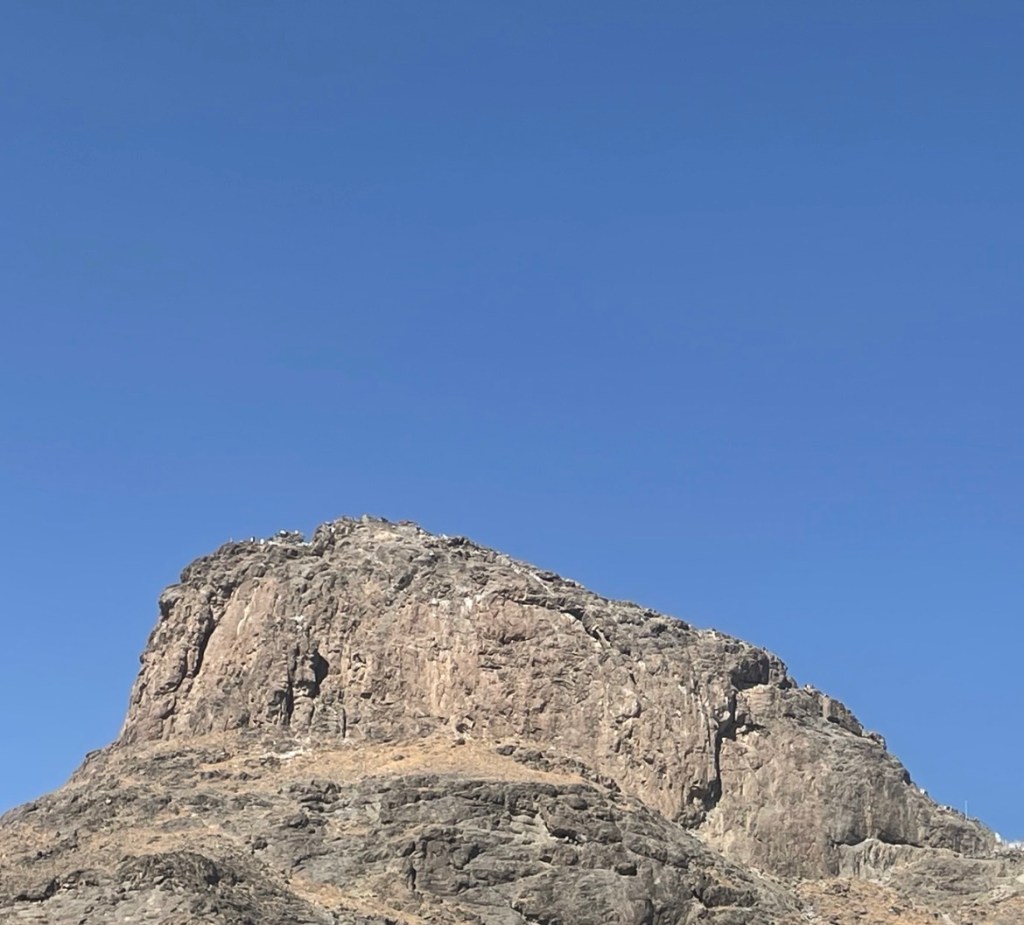
Jabal al-Nour/Mount Hira
We were among those who had heard the Prophet of Islam say, God is One, and our souls were filled by the Presence of the Supreme One.
We have now come to recall all the teachings, all forming as though a chandelier hung from the Hand of God between the heavens and the earth.
We have come to uncover all the Tablets, open all the Books, unlock all the Doors, and bring all things to Man/Woman for Man/Woman is all things.
We have come to make everyone see oneself in all things and all things in oneself. So long as one holds fast to the Unity of Unities one is secure, and there is no danger to his/her devotion to the One.
Yes, we shall transform the world by making each one of us wake up from the nightmare of separatism and exclusivism. Then each heart will hear the divine whisper clearly showing the way to universal good, love and peace. Then we shall care for one and all.
In each mind and heart we shall set the wheel of universal consciousness in motion. We are the enhanced horizon of hope. We are the larger reaches of being. We are the drumbeat of the advancing victory of universal love.
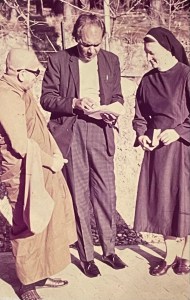
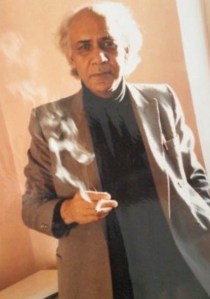
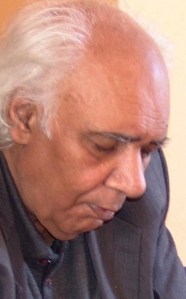
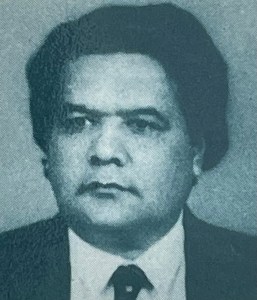
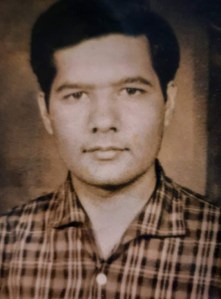
Professor Syed Hasan Askari – 1932-2008 (s/o late Syed Ali Naqi) graduated in 1947 from High School, Darush Shifa, Hyderabad, with a Higher Secondary Certificate. He was examined in the subjects Urdu, English, Indian History, Ethics, Civics, Geography and History of Islam. It is perhaps this breadth of early education that laid the foundations for his stellar academic achievement to come in the fields of sociology followed by a pioneer of inter religious dialogue.
In 1956 he attained his Masters in Sociology from Osmania University, Hyderabad, an institution at which he would take up the respected role of Lecturer in Sociology 1957-1975. In March 1976 further success ensued in attaining his PhD, Doctorate in Philosophy, with his thesis on “Social Symbolism” from Osmania University. By this time he was invited abroad in 1972 as a visiting professor to the American Free University in Beirut, Lebanon*. Between 1975 – 1977 he was Chairman, Department of Sociology, at the prestigious Muslim Aligarh University, India.
With his reputation growing in the field of inter religion he came increasingly to the notice of European institutions taking up a visiting professorship in Amsterdam and subsequently invited as Professor to the U.K. Selly Oak Colleges, Birmingham University, Centre of Islam and Christian Muslim Relations 1978-1982. As a result of this offer he made the important decision with his wife, Liaqat Begum1942-2007 (d/o Aga Mumtaz Hussain), to relocate the family moving to the U.K. with their three Sons.
In his seminal speech in 1995 about his life’s work, delivered in Hyderabad, on his last ever visit back to his beloved city, he states, “I had discovered the limits of social science. I was moving towards philosophy and towards meta-physics…My main anchor was the West after 1977. I was rubbing shoulders with theologians and professors and thinkers across the world…I turned to Plato and to Plotinus; those great thinkers who influenced the West and also the Islamic world as my teachers. So in late 1980s I decided to revive what we in philosophy call the *classical discourse on soul.”
Professor Askari’s stature as a scholar and thinker was acknowledged in his lifetime by figuring asone of the eight important Muslim thinkers of the last century in Bishop Kenneth Cragg’s book “The Pen and the Faith.” Professor Askari is acknowledged in the West as an uncompromising advocate for inter-religious spirituality. Professor Jane I Smith (Harvard Divinity School) writes about Professor Askari as being, “a long time partner in dialogue sessions sponsored through the World Council of Churches and other agencies, Askari has been a courageous and sometimes lone voice …Those who have known him through the years find it no surprise that the noted interpreter of Islam, Anglican Bishop Kenneth Cragg, has acknowledged Hasan Askari as one of the eight prominent Muslim thinkers of this century(20th) in “The Pen and the Faith.” A philosopher, a mystic, an historian and a social scientist, Askari pleads with religious persons everywhere to transcend the limitations we have placed on ourselves and to move together to new levels of understanding.”
Dr Charles Kimball writes, “Hasan Askari is among the most active and visible Muslims engaged in interreligious dialogue.* Since 1970, he has participated in numerous international and local dialogue meetings and lectured widely on various dimensions of what he terms “inter-religion”…His prominence in the field of Christian-Muslim encounter is noted by Kenneth Cragg, a pioneer and acknowledged authority in the area of Christian-Muslim relations”
Professor Askari has taught at several universities including, Osmania, Aligarth, Beirut, Amsterdam, Birmingham (UK), Lebanon, Germany, Holland, United States, and has been a visiting professor at the universities of Antwerp and Denver. He was also the Louise Iliff Visiting Professor at the Iliff School of Theology in Denver (it was while teaching at Iliff that Professor Askari was interview by local radio, audio of those three inspiring interviews is also available on this blog). Professor Askari has been the first Muslim to address the Conference of European Bishops (Vienna 1985), and the International Council of Jews and Christians (Salamanca 1986). He has also given special lectures at several universities – Tehran, Frankfurt, Heidelberg, Nainz, Gottinghem, Rome, Utrecht, Leiden, Aberdeen, Oxford, Cambridge, Harvard, Uppsala and Stockholm.
Professor Askari’s international reputation rests on his vast experience as both consultant and participant at several international conferences and seminars on inter-religious dialogue: Ajoultoon 1970, Broummana 1972, Colombo 1974, London 1974, Bellagio 1976, Freiburg 1976, Beirut 1977, Hamburg 1982, Hanover 1984, The Hague 1985, Hartford 1982, Philadelphia 1986, Amsterdam 1990.
Professor Syed Hasan Askari’s works include: The Experience of Religious Diversity – co edited with Professor John Hick 1984. Spiritual Quest – An Inter Religious Dimension 1991, Towards a Spiritual Humanism – A Muslim Humanist Dialogue 1991. Alone to Alone : From Awareness to Vision 1991. Seers & Sages (co-edited with David Bowen) 1991. Solomons Ring : The Life and Teachings of a Sufi Master 1997 – dedicated to his late father. Selections from The Orations of Imam Ali ibn Talib, Hyderabad, 1965 (Urdu),Foundations of Applied Sociology, Allahbad, 1968. Inter-Religion, Aligarh, 1977. Society and State in Islam: An Introduction, Delhi, 1978. Reflections of the Awakened, Cambridge 1984.
From Darush Shifa to Osmania, from Aligarh to Europe, from the United Kingdom to the United States, Syed Hasan Askari lived an extraordinarily rich life of personal achievement, high academic standing and an intellectual stature of original thought that continues to resonate to this day. From Sociology to Inter Faith Dialogue to the revival of the classical discourse on soul Professor Syed Hasan Askari leaves behind a tremendous body of work from which future generations may derive much needed inspiration.
Syed Hasan Askari passed away on 19th February 2008, at exactly 7am, in a small town in the North East of England, surrounded in person, and in spirt, by members of his Family. It was a cold foggy morning, frost on the ground. All was still, birds were busy in their morn song. He is survived by his three Sons to whom he dedicated his book, Spiritual Quest, a collection of his lectures.
One who is of a different race or colour is not an alien; nor one who is of different sex or age; nor is one the alien who practises a different art or craft, or belongs to a different class or caste; and nor one who believes differently, nor the stranger nor a foreigner. None of these is alien but one who is closest to you, who has possessed you from the very outset of your consciousness, who passes for your likeness, who has foisted himself on your back, who is your counter-image. If you are an unembodied reality, he presents you with body; if you trace your race with the archetype above you, he cites the evidence of your parents; if you relate to life beyond death, he ridicules you and brings in a vast range of arguments against it; it puts on your appearance, your face and your name, and a time comes when you end up regarding him as your only reality.
This appearance now so firmly entrenched as your identity fully utilizes your physical self and the body of the world to force upon you a constant dream-state. Its one fear is that you should not wake up.Your awakening is its departure.
The counter-image has vast negative powers. Its success in passing for reality gives it a power to wreck life after life. Watch for those who assume the role of a counter-image of your true self.
Let us make this affair as clear as possible: first is the Soul which has nothing to do with body for its existence, knowledge, and power; then is the body, the creation and expression of the wisdom and art embedded in the Cosmic Soul; and then the conjoint of body and soul, the seat or instrument of your perceptive knowledge and of your pains and pleasures, a tool or a lyre in the hands of its true agent, namely the Sage or the Gnostic. But so far the Alien is not in sight. But he is close, almost upon you for he is the image of the conjoint in your tendency to self-will and self-ownership. The image soon takes over.
The image is the alien, not the body, not the conjoint of body and soul*.
The image as such isolates you from all your former and future lives. It obstructs your awareness on matters that go far beyond one life you are living now. It does not allow you to consider that you are perhaps back to pay for a former lapse or debt, to complete things left incomplete in former life, and that you may rise higher or fall lower as you eventually leave this world. So you are like Sinbad. Ask the one who has foisted himself upon you to get off from your back so that you can once more rise to your full stature and look further into vast distances both before you and behind you.
There is a Love among siblings, one where their parents have departed from this world. The siblings begin to see one another slowly through the eyes of the love of their parents for their children. It is a subtle and beautifully almost invisible gift. Akin to seeing an empty chair in one moment and at the same time to sense a “presence,” a memory, a treasured word, a glance recalled.
In all the trials of life and pain, doubt and heartache, love and forgiveness of each other how uplifting to ask for Gratitude to soar like an eagle above the earth. The earth where our troubles and joys are found but Gratitude takes one inner and higher. It is to the other world. Another world where equality and peace reign upon the earth or otherworldly, altogether spiritual, non-material.
Ask first that your Gratitude for all you have shines high like an eagle so that in comparison your troubles seem small and as such you are given great strength and confidence to face and inshallah overcome them by yourself or with the assistance of some anonymous solidarity.
Oh Allah, God of Abraham, Solomon, Moses, Mary, Jesus, Muhammad (peace be upon them All) improve my gratitude/shukar to You Alone. Not gratitude to my memories (good or ill) nor to my personal achievements, nor to wealth or poverty, nor to charity, nor to my sense of arrogant self-righteousness, even though I may feel justified. All Justice is Yours to dispense or otherwise.
Gratitude to You Alone oh Allah. All is from You.
Nothing is of my doing but by choosing of this or that thing, this or that emotion to dominate my mind and heart. Nothing is of my doing but what I choose and accountable for.
Poetry is still one of the dominant modes of reflection and self consciousness in the Orient. It has somehow survived amidst all the threats a growing industrial culture presents, particularly in its impersonalising effects. In spite of all the stark contrasts of poverty and wealth, power and powerlessness, poetry, whether it is traditional or modern, continues to impart to people’s minds and hearts a sense of idealism and warmth.
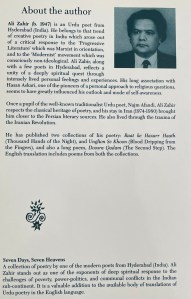
Ali Zahir (19th February 1947 – 16th March 2003) is from Hyderabad, one of the major cities in India, a meeting point of several streams of cultures, religions and languages. Formally ruled by a Muslim prince, and now a part of the Indian Republic, Hyderabad has gone through a series of political, economic and cultural transformations which have led to the breakdown of old values, both religious and humanitarian, giving way to imbalance between the personal and the collective dimensions of people’s lives. Though Hyderabad maintained for a considerable time a sense of communal harmony which was fast disappearing from the other parts of India, it has collapsed over the last two decades into periodic outbursts of inter-religious hatred and violence thus wrecking the eclectic foundations of its semi-feudal culture.
Writers have responded to the challenges of modern India in three distinct modes – traditionalist, marxist, and modernist. The traditionalist approach involves the continuation of the classical literary forms, nostalgia for the late mediaeval culture, and a formal adherence to the rules and forms of art and poetry. The Marxist or the progressive school which thrived from the middle forties to the late sixties rested on a confident ideological mood that art and literature should reflect the people’s struggle against capitalism and imperialism. The modernist approach came about as a reaction to both the traditionalist and the marxist perspectives and claims. It was a revolt against formalism, both of form and ideology. It reflected the cry of the lonely individual for identity, recognition and communication. All the three modes have been generally humanist an agnostic.
Ali Zahir’s poetry reflects the traditionalist respect for form and the modernists emphasis on subjectivity. Having experienced the changes his city has undergone over the recent decades and also having worked in Iran during the years preceding the revolution there, Ali Zahir could witness the extremes from spiritual vacuum to religious enthusiasm. He could see both outside and deep within himself an urgent need for a new religiosity or sensitivity to both the psychological and political challenges. His poetry is one of the modes in which he expresses this quest.
The search begins with perception and remembrance of the human situation, of that predicament that envelops all humanity. Ali Zahir takes notice of the tragedies of the communal riots right within his own city, and points to the irrelevance of all the instructions of philosophy and ideology.
At the edge of the death of each abstraction
There is the mother, sister, brother –
Such tangible realities
Noticing the failure of both secularism and religion to give to India any relief from poverty and exploitation, Ali Zahir says:
For the oppressed and poor and humble, philosophy is a mockery that drains their very life force.
However critical of all those abstractions which empty the nations of the resources of humanity, Ali Zahir is drawn to the metaphysical mystery at the heart of life’s expressions both in pain and creativity.
“What is all this, dream or reality?” he asks.
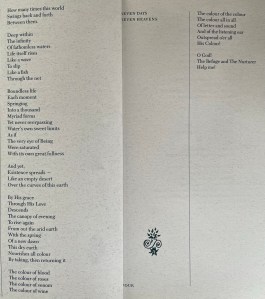
The mood of his beautiful poem, Seven Days, Seven Heavens, bears witness to his quest for harmony, for meaning, and for the unity of reality behind all number and image:
Seven days
Seven heavens unfurled
Seven colours
Seven sounds
Architects of harmony.
From chaos to order, from loss of meaning to recovery of purpose, there is both a lifelong striving and at times a sudden leap into the depths of one’s being.
Within the heart
A spring
And within the spring, a flame
And within this flame of elemental yearning
There is another flame
The one which we call life.
Life, that mysterious all-embracing joy overflowing every cup and even at times drowning in its ecstasy the cupbearers as well, is one unending call of love, both the caller and the called all at once. There is the hearth of all reality – there is the abode of meaning and purpose. Hence, Zahir so truthfully regards all life as continuous communication, and he wonders: “How many garments that one spark has changed?”
Drawn to the heart of his own mystery, rejoicing in the variety of colours that one colourless unity puts on, and waiting at sunrise to hear the call of the “white moments” inviting him to step inward and then look, Ali Zahir brings to us in his poetry a new sensitivity nurtured in pain, linked with loneliness – a new religiosity without forms and rituals but not without courage and responsibility for both our inner and outer transformation. Those who are looking for the unity of mind and heart will find in Zahir’s poetry one of its most moving examples from the Indian subcontinent.
Hasan Askari
See also Hasan Askari’s 1995 speech in Hyderabad on Spiritual Humanism at which Ali Zahir and Musa Askari were present…. Hasan Askari says… “On that morning I said to Ali Zahir well, still there is light in this country. And perhaps we should begin from here again. Because in Indian tradition no other culture today talks about the soul so clearly and so continuously as India does.”
“I did not ask to be born,” he said. “I did not ask for my eyes. I did not ask for my face. I did not ask for my ears. I did not ask for my hands. I did not ask for my feet. I did not ask for anything that one may call a Body. I did not ask for I did not even know what even a body was. I did not ask for my Parents. I did not ask for my Family. I asked for none of these things for I had no idea of what they were. I did not ask for companionship. I did not ask for friendship. I did not ask for food to eat, for shelter nor for warmth. I asked for none of these things for I knew not what they were. I was in no lack or want of any such thing.”
“Who are you to not ask or need for such things?”
“All I know, all I remember, all I recollect, and know to be true, the one certain thing, that I am a soul. Yet I did not even ask to be a soul.”
“I did not even ask for my name. All these, given not by myself to myself. Given unknown and unbidden by the Giver of All. For what purpose, for what reason unknown to me and I shudder to ask. That I cannot ask.”
“If all such have been given and given in abundance with no memory of my calling for them, who is the Giver that gives as such? Pray tell so that I may give thanks and thanks in perpetuity. All I ask is to whom I offer this thanks. For thanks and much more is due. That is the only thing I can ask. To know where the offering of gratitude is to be placed.”
“But first I must pay attention to this Body ahead of that offering. Where is the place for wadhu (ablution)?”









 One who is of a different race or colour is not an alien; nor one who is of different sex or age; nor is one the alien who practises a different art or craft, or belongs to a different class or caste; and nor one who believes differently, nor the stranger nor a foreigner. None of these is alien but one who is closest to you, who has possessed you from the very outset of your consciousness, who passes for your likeness, who has foisted himself on your back, who is your counter-image. If you are an unembodied reality, he presents you with body; if you trace your race with the archetype above you, he cites the evidence of your parents; if you relate to life beyond death, he ridicules you and brings in a vast range of arguments against it; it puts on your appearance, your face and your name, and a time comes when you end up regarding him as your only reality.
 The image as such isolates you from all your former and future lives. It obstructs your awareness on matters that go far beyond one life you are living now. It does not allow you to consider that you are perhaps back to pay for a former lapse or debt, to complete things left incomplete in former life, and that you may rise higher or fall lower as you eventually leave this world. So you are like Sinbad. Ask the one who has foisted himself upon you to get off from your back so that you can once more rise to your full stature and look further into vast distances both before you and behind you.






 Spiritual Human